
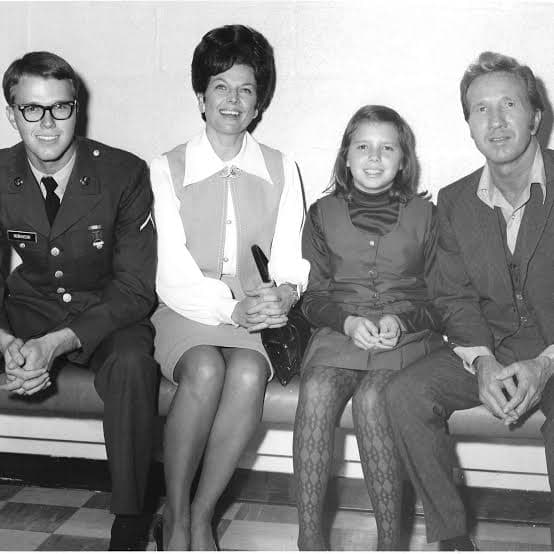
A SON’S WHISPER THROUGH THE GUNSMOKE OF MEMORIES
In a dimly glowing country‑music hall, when the first notes of “El Paso” drift into the air, time seems to freeze — the dusty saloon, the dancing silhouette of Feleena, the echo of a fatal gunshot, the ache of longing and regret. In that moment, the story lives again, carried not only by the voice that first sang it, but by the son who refuses to let its fire die. In choosing to perform his father’s signature song, Ronny Robbins honors more than a melody. He honors a legacy, a memory, and an entire world painted in moonlit deserts and heartbreak.
In doing so, Ronny isn’t simply covering a classic — he is offering a tribute to Marty Robbins, whose 1959 release of El Paso from the album Gunfighter Ballads and Trail Songs became a benchmark in the country and western canon. That original single ascended to number one on both the Country and Pop charts as the new decade turned in 1960.
The Echo of a Ballad Reborn
“El Paso” is more than a song — it is cinematic in scope, dramatic in pacing, haunting in its final lines. Marty Robbins crafted it as a Western ballad deeply rooted in the Hispanic‑influenced musical vernacular of the border: romantic, dangerous, beautiful, tragic. The song recounts the tale of a cowboy who wanders into “Rosa’s Cantina” in the border town of El Paso, falls under the spell of a dancer named Feleena, and — torn by jealousy — kills a rival, flees, only to return and meet his end in Feleena’s arms.
With its shifting tenses — from nostalgic recollection to breathless present — and the shimmering Spanish‑guitar flourishes from guitarist Grady Martin plus subtle harmonies, the song evokes a living, breathing world. In the final verse, as the narrator’s life slips away, you can almost feel the desert wind through the strings, hear the dust settle on one last breath. It’s the kind of storytelling that turns a four‑minute song into a memory you carry with you.
Why the Song Lives On
The success of “El Paso” was never just about charts or awards — though it did earn a Grammy for Best Country & Western Recording. What made it endure was its capacity to conjure an entire world with guitar, voice, and sorrow. It helped define the Western‑ballad subgenre. It inspired future songwriters to weave narrative, setting, and emotion into songs that read like short stories set to music. For decades “El Paso” has remained a touchstone — covered by generations of artists, reinvented for new audiences, revisited by those who sense its haunting power.
The Significance of Ronny’s Tribute
When Ronny Robbins steps up to sing “El Paso,” the act becomes deeply symbolic. He carries with him not only the cadence of a famous father, but the weight of preservation. In his performances — particularly the one captured on the show Country’s Family Reunion — listeners often remark that his voice evokes the same supremely expressive tone, the same ache of longing and regret, as his father’s.
But more than mimicry, Ronny’s delivery feels like memory made flesh: a son reaching through time, inviting listeners to stand once more in that dusty cantina, feel the swirl of a dancer’s skirt, hear a heart‑racing gunshot, and witness love entwined with fate. That performance is testament to the idea that music, like blood, can carry more than sound — it carries soul.
In giving “El Paso” a second life, Ronny Robbins does more than honor his father. He ensures that the sorrow, beauty, and final kiss of the cowboy’s story will continue to echo in hearts unacquainted with the West — proving that some songs never die.