
SOUL‑WEIGHED SADNESS THAT DROWNS THE HEART
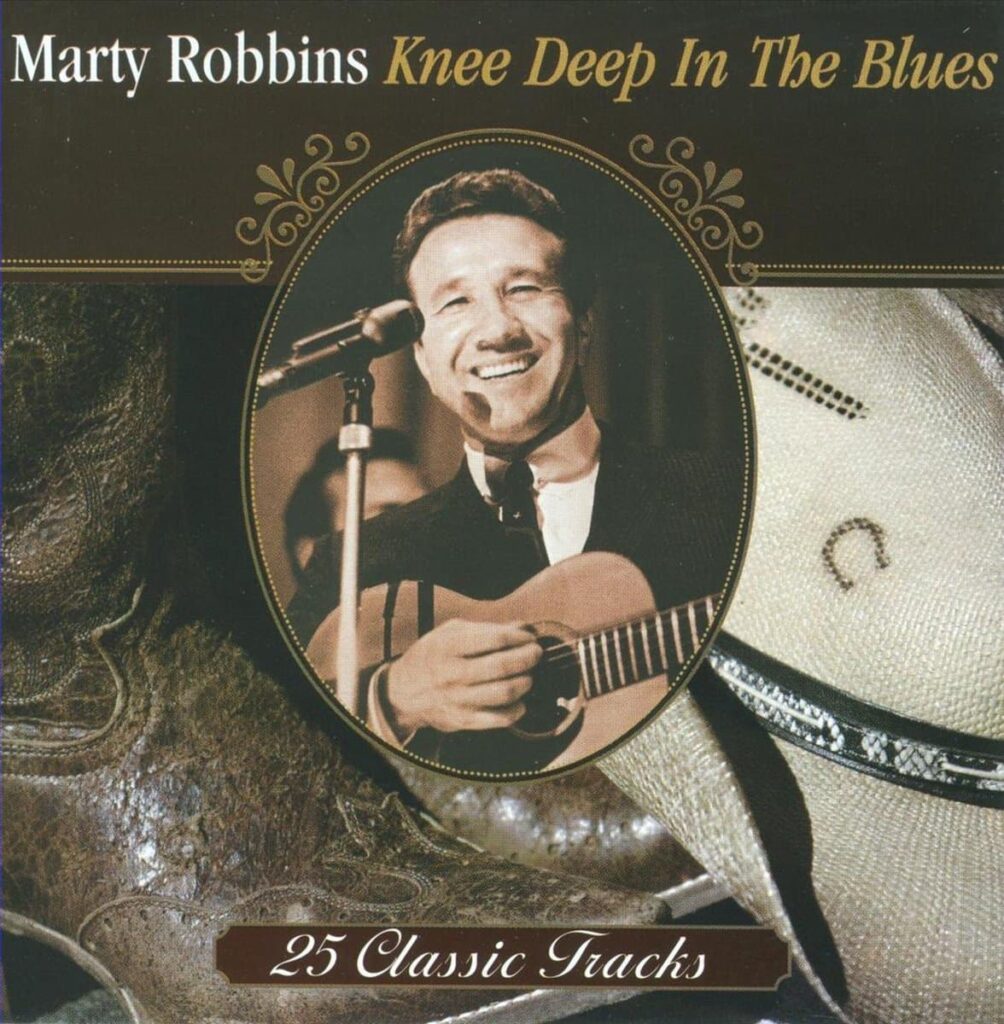
When Knee Deep in the Blues by Marty Robbins first waded into public ears in December 1956, it surfaced as a single on Marty’s Greatest Hits, rising to No. 3 on the Country Singles chart. From the first haunted line until the final strum, the song held the air of a mournful confession, a painful echo of heartbreak given shape by Robbins’s voice and by the aching melody written by Melvin Endsley.
In the plain confession of “I’m just knee deep in the blues,” Robbins asks no grand metaphors. He offers only a man weighed down by sorrow, each lyric a step further into the mire of grief. The song does not dramatize heartbreak with cinematic flair. It sits quietly in a room where sorrow is familiar, a room where the floorboards creak with memory, and the walls close in because the love that warmed them is gone. The sadness is not explosive but pervasive — the kind that lingers long after the lights are off.
The circumstances surrounding the recording reflect a restless, creative moment for Robbins. At that time, he was still navigating between “country,” “pop,” and “honky‑tonk” identities — trying on different sounds, telling different stories. The choice of “Knee Deep in the Blues,” written by Endsley and recorded by Robbins on December 4, 1956 in Nashville under producer Don Law, felt like a statement: a return to raw emotion, a nod to traditional country sorrow just as rock and roll was crossing over into the mainstream.
Lyrically, the song embraces simplicity — simple images of walking “the soles off of my shoes,” skies turned grey, life drained of purpose. Yet the simplicity serves the song’s emotional potency. There is no pretense, no theatrical heartbreak. Just a man speaking plainly, his heart heavy, his nights too long, his tears flowing. The voice of Robbins carries that sorrow without exaggeration; the arrangement supports it without gloss. The result is a track that feels like an open wound from which grief pours out in the lonely rhythm of acoustic strings.
Musically, “Knee Deep in the Blues” sits at the crossroads of post‑war country and early honky‑tonk balladry. It channels the mood of mid‑50s country music — a genre in flux, borrowing from blues sensibility while clinging to the storytelling heart of country traditions. For Robbins, it revealed a capacity for emotional nuance that contrasted with some of his more jaunty or narrative‑driven numbers. This ability to inhabit sorrow, to make the listener feel the weight of grief, would become one of the hallmarks of his artistry in later years.
In the broader arc of Robbins’s career, “Knee Deep in the Blues” occupies a curious space. It was neither the runaway pop crossover of some of his later hits nor the dramatic epic of his Western ballads. Instead it stands as a raw, intimate snapshot — a moment when Robbins let pain speak for itself. It’s a song that does not offer redemption or resolution. It only offers the truth of sorrow — immersive, unvarnished, and achingly human.
Today, listeners who return to the song are drawn not by chart history but by that emotional honesty. The track remains a testament to the power of simplicity and sincerity in country music — proof that sometimes the deepest truth is spoken in the quietest words.