
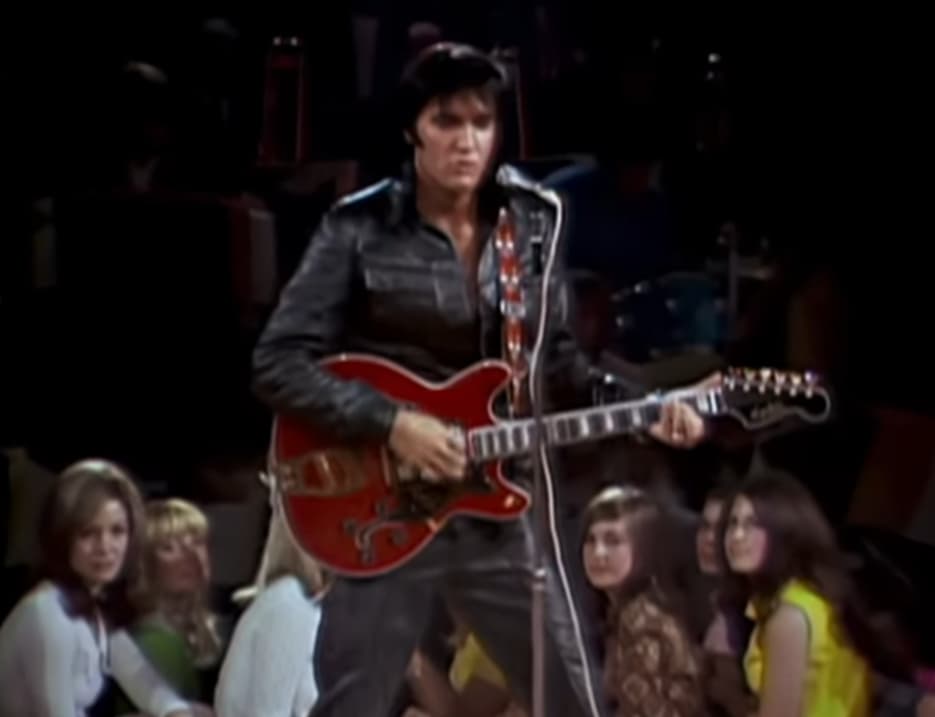
A Man Reclaims His Crown With a Guitar, a Sneer, and Three Minutes of Pure Rock & Roll Defiance
When Elvis Presley tore into “Blue Suede Shoes” during the legendary ’68 Comeback Special, he was not merely revisiting an old hit — he was reclaiming his identity in front of the entire world. Originally released by Carl Perkins in 1955 and immortalized again through Elvis’s own 1956 recording for the album Elvis Presley, the song had already become one of rock & roll’s defining statements. Elvis’s original version reached No. 20 on the Billboard Top 100 while dominating country and rhythm & blues markets simultaneously, helping cement his unprecedented crossover appeal. But by 1968, the meaning of the song had changed entirely. What once sounded youthful and playful now carried the force of resurrection.
The context surrounding the performance matters as much as the song itself. By the late 1960s, Elvis had spent years trapped in a cycle of increasingly forgettable Hollywood musicals. The dangerous young man who once scandalized television audiences had become polished, distant, almost mythological rather than alive. The NBC television special, later celebrated simply as the ’68 Comeback Special, shattered that illusion in one electrifying night. Dressed in black leather, sweating under harsh lights, Elvis stood before a small audience and sounded hungry again. That hunger is what gives “Blue Suede Shoes” its extraordinary power in this performance.
The song itself has always been deceptively simple. On paper, its lyrics revolve around material obsession — “you can do anything, but lay off of my blue suede shoes.” Yet beneath the humor and swagger lies something deeper: personal dignity. In the world of early rock & roll, those shoes symbolized identity, style, pride, and individuality. They represented the postwar youth culture that refused to inherit the cautious restraint of the previous generation. To touch those shoes was to violate a man’s sense of self.
Elvis understood this instinctively. What makes his 1968 rendition unforgettable is the way he transforms the song from novelty into declaration. His phrasing is sharper, more playful, and yet strangely more aggressive than in the 1950s studio cut. Every grin carries an edge. Every hip movement feels less choreographed and more instinctive. He is not acting like Elvis Presley anymore — he is Elvis Presley again.
Musically, the arrangement strips away excess. The performance thrives on tension between raw guitar lines, snapping rhythm, and Elvis’s deeply rhythmic vocal attack. There is almost a garage-band intimacy to it, especially during the informal “sit-down” segments of the special. That looseness became essential to the mythology of the comeback. Rock music itself had evolved dramatically by 1968 — psychedelic experimentation, political unrest, and heavier sounds dominated the era — yet Elvis managed to remind audiences where the rebellious heartbeat of rock began in the first place.
What lingers most about “Blue Suede Shoes” from the ’68 Comeback Special is not nostalgia alone. It is the feeling of witnessing an artist rediscover his own pulse. Many performers revisit old songs as museum pieces. Elvis attacked this one like unfinished business. The performance stands today not simply as a tribute to early rock & roll, but as proof that charisma, conviction, and raw musical instinct can survive even years of artistic drift.
For many viewers in 1968, this was the moment they realized the King had never truly disappeared. He had only been waiting for the lights to dim, the leather jacket to tighten around his shoulders, and the band to count off the beat one more time.