
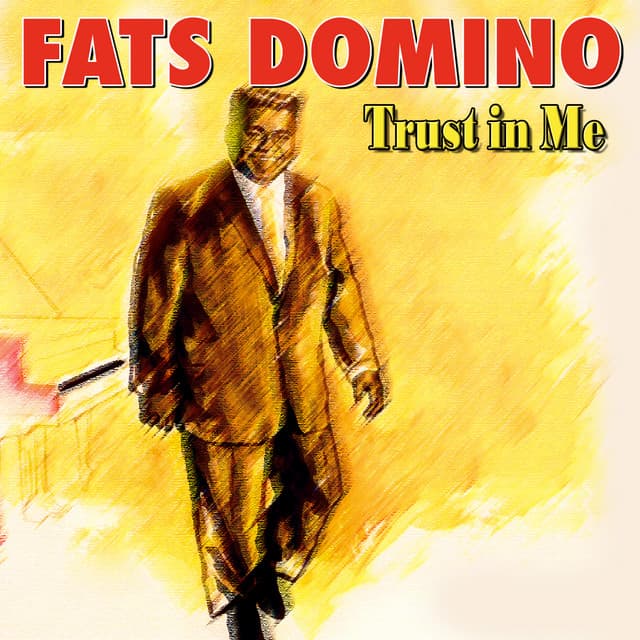
A Joyful Boogie to Birth a New Era
In The Fat Man’s Hop by Fats Domino, there is the crack of a piano key that seems to split time itself and usher in a new dawn for American music.
When the song appeared — on the album This Is Fats Domino (sometimes known in various reissues as part of his mid-20th-century catalog) — it came from an artist already redefining rhythm and blues. Though precise chart data for The Fat Man’s Hop is sparse in public archives, the lineage that produced it is unmistakeable: Domino had already established himself with The Fat Man, recorded in December 1949 and released in early 1950, which climbed to No. 2 on the R&B chart and went on to become widely regarded as the first rock and roll single to sell one million copies.
It is within that historical momentum that The Fat Man’s Hop arrives — not simply as another track, but as a continuation of a musical revolution.
The Legacy Behind the Groove
To understand the resonance of The Fat Man’s Hop, one must first look to its forebear, The Fat Man. That 1949 recording — a collaboration between Domino and producer-co-writer Dave Bartholomew — reworked a traditional New Orleans blues number, “Junker Blues”, stripping it of its darker themes and refashioning it into something energized, bold and dance-ready. With its barrelhouse piano triplets, strong backbeat, and Domino’s playful vocals — complete with scatted horn-like syllables — the song captured both the grit and the groove of New Orleans after dark.
This transformation was not incidental. Domino and Bartholomew didn’t merely cover an older tune — they reinvented it. They preserved its bluesy soul while accelerating its pulse, embedding in it the seeds that would sprout into rock and roll. Many historians now consider The Fat Man to be among the first rock and roll records, or at least a defining bridge between jump-blues and the rock-and-roll explosion to come.
By the time The Fat Man’s Hop emerged, Domino had already proven the power of that formula. The “Hop” feels like a further step — a nod to good-time dancing, to the crowded dance halls of New Orleans, to a generous invitation: “Come feel the beat, come stomp your feet.” It carries forward the rolling piano, the strong beat, and the sense of communal celebration first crystallized in The Fat Man.
The Emotional Pulse of the Song
At its core, The Fat Man’s Hop is more than a track — it is a statement. It captures the joy of physical motion, the release of rhythm, the shared energy of people dancing close in dimly lit clubs. Domino’s piano — rhythm-heavy, confident, but never overstated — becomes both locomotive and heartbeat. The horns (if present) and bass hold fast, creating a groove that feels rooted in the street rhythms of New Orleans and yet ready to sweep listeners across the country.
The lyrics — where Domino’s voice sometimes grins at you, sometimes shouts with exuberance — speak to an essential human urge: to move, to lose oneself, to celebrate life in the moment. In those surging triplets and that pounding beat there is pride: pride in physical presence, in identity (his “Fat Man” nickname), in the ability to command a room not with fancy words or pretension but with piano, rhythm, and soul.
Cultural Significance and Aftermath
While The Fat Man’s Hop may not enjoy the same canonical status as The Fat Man, Ain’t That a Shame, or Blueberry Hill, it represents an important strand of continuity in Domino’s work — the playful immersion in rhythm that made him a foundational figure in early rock and roll. That groove-first, piano-driven sensibility influenced countless artists who would follow, helping pave the way for the rock explosion of the mid-1950s and beyond.
Moreover, the song stands as a testament to the milieu from which Domino emerged. The New Orleans clubs, the smoky juke joints, the creole neighborhoods — all fed into a musical ecosystem where blues, jazz, R&B, and boogie-woogie intertwined. In The Fat Man’s Hop, listeners hear not just one man at the piano, but an entire city’s heartbeat given rhythm and life.
And so The Fat Man’s Hop deserves to be heard not as a minor footnote, but as a living continuation of a musical revolution — a hymn to movement, to joy, to the power of groove, and to the enduring spirit of a style that changed everything.