
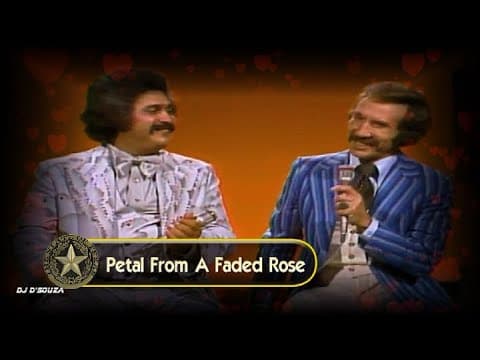
A Television Stage Became a Meeting Place for Two Lonely Voices Carrying the Weight of the American Heartland
There are performances that exist merely as entertainment, and then there are those rare televised moments that feel preserved in amber — fragments of an era when country music still carried the dust of border towns, neon taverns, and midnight highways. The appearance of Freddy Fender on The Marty Robbins Show belongs firmly to that second category. By the time Fender emerged as a crossover phenomenon in the mid-1970s, his heartbreaking hit “Before the Next Teardrop Falls” had already climbed to No. 1 on both the Billboard Hot Country Singles chart and the Billboard Hot 100 in 1975, appearing on the album Before the Next Teardrop Falls and transforming him from a regional Texas voice into a national sensation. Beside him stood Marty Robbins, already an institution — a man whose catalog, particularly through albums like Gunfighter Ballads and Trail Songs, had long defined the cinematic possibilities of country storytelling.
What makes these television performances so enduring is not spectacle. Neither man relied on theatrical excess. Their power came from restraint — from the weary dignity in their phrasing, from the way silence lingered between verses like smoke hanging in an old dance hall. Marty Robbins had always understood narrative tension. Whether singing of doomed lovers, wandering cowboys, or quiet regret, he approached songs as living stories rather than commercial products. Freddy Fender, meanwhile, carried something even more fragile into the room: vulnerability that felt entirely unguarded.
Fender’s voice was unlike the polished Nashville standard of the era. There was a tremble inside it, a bruised tenderness shaped by hardship, addiction, prison time, and years spent drifting through the margins of the music business before fame finally arrived. When he sang, listeners heard survival. That is what separated him from so many contemporaries. He never sounded as though he were performing sorrow; he sounded as though sorrow had permanently altered the grain of his voice.
Placed alongside Robbins, the contrast became fascinating. Robbins possessed the commanding elegance of a seasoned storyteller — measured, controlled, almost orchestral in his delivery. Fender, by comparison, seemed emotionally exposed, singing with the intimacy of a man confessing secrets after midnight. Yet together, they represented two complementary traditions inside country music: the mythic West of Robbins and the deeply personal borderland melancholy of Fender.
The cultural importance of programs like The Marty Robbins Show is often overlooked now, particularly in an age dominated by fragmented streaming clips and algorithmic discovery. In the 1970s, these broadcasts functioned as communal rituals. Families gathered around televisions not simply to consume music, but to encounter personalities and stories. Artists were allowed space to breathe. Songs unfolded patiently. The camera lingered on faces instead of cutting every few seconds in search of stimulation. That slower rhythm gave emotional authenticity room to settle into the audience.
Listening today, what remains most striking is the humanity of it all. There is no ironic distance, no calculated coolness. These performances belong to a generation of country artists who understood heartbreak not as a stylistic accessory but as a lived reality. Robbins brought grandeur to loneliness; Fender brought intimacy to pain. Together, they created the kind of musical conversation that modern country television rarely captures anymore.
And perhaps that is why these recordings continue to resonate decades later. They remind listeners of a time when country music still trusted quiet emotion — when a trembling voice and a simple melody could hold an entire room still.