
Some men spend their lives running from the world; others leave behind a legend the world never forgets.
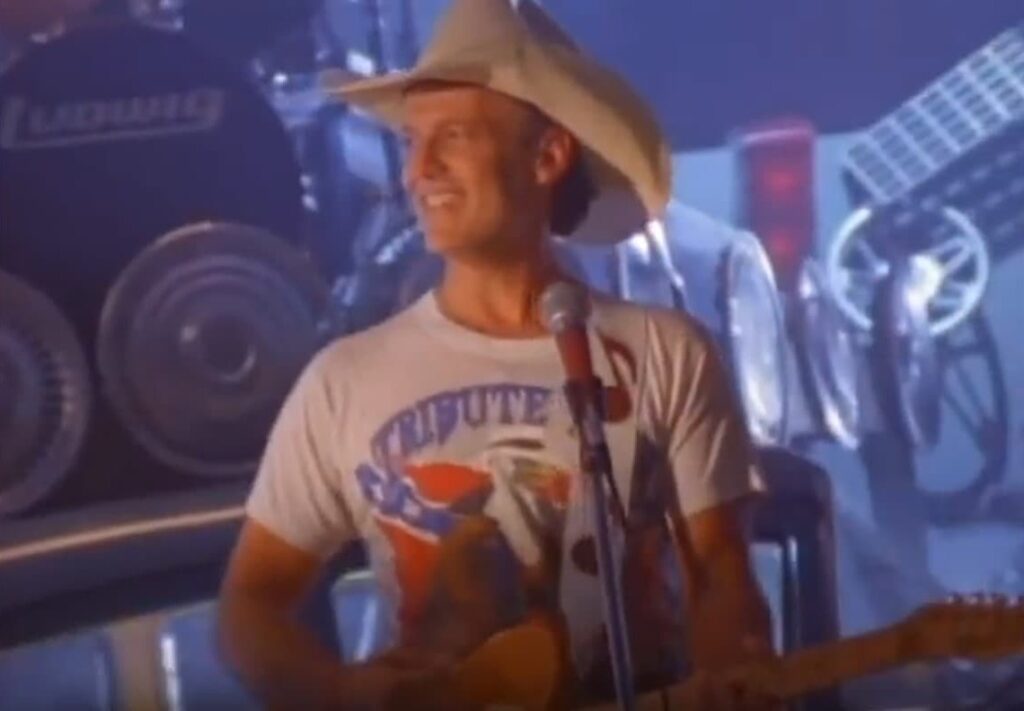
Released in October 1992 as the second single from Ricky Van Shelton’s Greatest Hits Plus, “Wild Man” climbed to No. 5 on the Billboard Hot Country Singles & Tracks chart and remained there for twenty weeks — a remarkable run that also marked Shelton’s final Top Ten country hit. Written by Susan Longacre and Rick Giles, the song arrived during a transitional moment in country music, when polished commercial production was beginning to overshadow the deeply human storytelling that had defined the genre’s golden decades. Yet “Wild Man” resisted that shift. It sounded lived-in, weathered, and deeply personal.
What makes the song endure is not spectacle, but restraint. Ricky Van Shelton never approached a lyric like an actor chasing drama; he sang as if memory itself had weight. In “Wild Man,” that restraint becomes the emotional engine of the entire recording. The narrator looks back on a father figure — rebellious, unpredictable, impossible to tame — with a mixture of admiration, grief, and understanding that only arrives with age. Country music has always treasured outlaws and drifters, but this song is less interested in romanticizing rebellion than in examining the emotional cost of living outside ordinary boundaries.
The genius of the lyric lies in its refusal to simplify the man at its center. The “wild man” is not portrayed as a villain, nor as a flawless folk hero. He exists somewhere in between: stubborn, restless, difficult, magnetic. The song understands that the people who shape us most profoundly are rarely the easiest people to love. That ambiguity gives the recording its lasting power. Many country songs of the era leaned heavily on sentimentality; “Wild Man” leans instead on recognition. It recognizes the complicated dignity of men who were built for open roads, hard living, and emotional silence.
Musically, the arrangement mirrors that emotional landscape with remarkable precision. The production remains understated — steel guitar drifting like distant memory, gentle percussion carrying the rhythm without urgency, and Shelton’s baritone grounded firmly at the center. There is no excessive flourish, no attempt to overpower the listener. Instead, the song unfolds patiently, almost conversationally, allowing every line to land with the quiet gravity of remembered truth.
By 1992, Ricky Van Shelton had already established himself as one of country music’s great traditionalists, a vocalist capable of carrying heartbreak without theatricality. While many of his contemporaries were embracing arena-sized production and crossover ambitions, Shelton still sounded rooted in the classic lineage of Merle Haggard, George Jones, and Keith Whitley — singers who understood that vulnerability in country music often arrives in whispers rather than shouts. In that tradition, “Wild Man” feels less like a radio single and more like an oral history passed between generations.
Time has only deepened the song’s resonance. For listeners who return to it decades later, “Wild Man” becomes more than a portrait of one unruly soul. It becomes a meditation on inheritance itself — the traits we resist, the traits we eventually understand, and the strange tenderness that arrives when memory softens judgment. Few country recordings capture masculine vulnerability with such quiet honesty. That is why the song still lingers long after the final note fades: not because it tells us who the wild man was, but because somewhere within the story, many listeners recognize someone they once knew — or perhaps recognize themselves.