
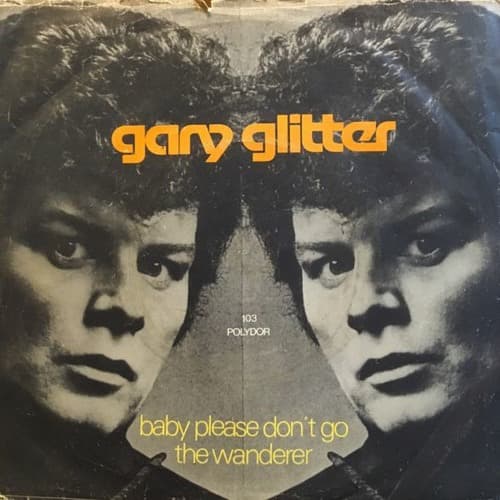
A plaintive plea carved out of early rock roots that channels the raw blues of its progenitors through the glam rock pulse of early 1970s British spectacle
Baby Please Don’t Go, interpreted by Gary Glitter, occupies a curious place in the sprawling tapestry of twentieth century popular music. Released on March 3, 1972 as an album track on Glitter, the singer’s debut studio LP produced by Mike Leander and issued on Bell Records, the recording did not chart as a single in its own right but formed an integral part of a record that broke into the United Kingdom Albums Chart top ten, peaking at number eight and helping define Glitter’s early commercial ascent. Glitter established his persona in the competitive terrain of glam rock and rock and roll revivalism, and Baby Please Don’t Go served as one of several covers on the LP that linked his brash, flamboyant style to the deep lineage of American roots music.
The song itself did not originate with Glitter. Baby Please Don’t Go is an American blues standard with origins that reach back to the Mississippi Delta, where Big Joe Williams first recorded a version in 1935 that carried the plaintive urgency of rural blues tradition into prewar recordings. That version, and many that followed by blues purists and rock interpreters alike, enshrined the theme of romantic abandonment and the threat of loss against the backdrop of itinerant life and hardship. Over the decades artists from Them with Van Morrison to AC/DC and Aerosmith have drawn from this lineage, each bending the song’s timeless cry to their own idioms.
Glitter’s rendition sits at an intersection of reverence and reinvention. Where the original recordings were steeped in Delta hollow and the guttural confession of separation, Glitter’s interpretation unfolds within the amplified bravura of early 1970s rock. Listening to the track today, one can hear the muscle of electric guitars and Glitter’s distinctive vocal projection as if he sought to recast the blues plea as a theatrical invocation. The song maintains lyrical fidelity to lines that echo across generations. “Baby please don’t go down to New Orleans,” the singer implores, repeating the refrain like a mantra against the inexorable pull of departure, the verses tracing a narrative of longing, the specter of another love waiting on the far side of tracks and the fear of solitary aftermath.
In this context, Glitter’s version becomes more than a simple cover it is an interpretive link between eras. In the early 1970s, as rock music was bifurcating into ever more stylized forms, artists often returned to foundational songs for grounding and legitimacy. For Glitter, whose image was crafted with theatricality and rhythm, Baby Please Don’t Go offered a chance to tap into the raw emotional reservoir of blues while showcasing his own performance energy. The result is a track that feels both retrospective and immediate, a bridge from the dusty cotton fields of blues lore to the spit polish of glam spectacle. In the album sequence it sits alongside original compositions and other reimagined classics, reminding listeners that rock’s vitality lies in its capacity to reinterpret and reanimate.
Today listening to Baby Please Don’t Go within Glitter reveals not only a recording of its time but a testament to the enduring power of a simple, aching plea. It remains an invitation for deeper reflection on how songs move across decades, reshaped by the voices that carry them, yet always anchored by the primal human fear of being left behind.