
A Jug of Moonshine, Two American Legends, and the Dangerous Freedom at the Heart of Country Music
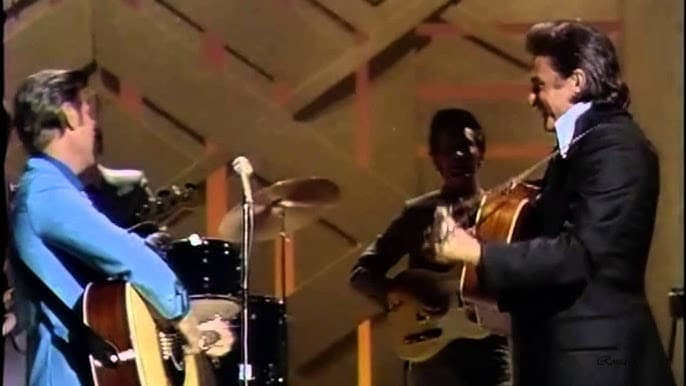
When George Jones recorded “White Lightning” in 1959, he did more than score his first No. 1 hit on the Billboard Hot Country Singles chart — he crystallized an entire strain of Southern mythology into less than three explosive minutes. Released on the album White Lightning and Other Favorites, the song became one of the defining records of Jones’s early career: raw, humorous, reckless, and steeped in the rural folklore of backwoods America. Years later, when Johnny Cash joined Jones in performing the song, the pairing felt less like a duet and more like a summit meeting between two men who understood the outlaw pulse running beneath country music better than almost anyone alive.
The story behind “White Lightning” is inseparable from the world that produced it. Written by the legendary rockabilly and country pioneer J.P. Richardson — better known as The Big Bopper — the song emerged from a Southern landscape where moonshine stills, dirt roads, and hard living were not romantic inventions but everyday realities. Richardson himself died tragically in the 1959 plane crash that also claimed Buddy Holly and Ritchie Valens, giving the song an almost ghostly permanence in American music history. Jones recorded it shortly afterward, and one can hear in the performance an urgency that borders on combustion.
What made George Jones extraordinary was his ability to sound both amused and doomed at the same time. In “White Lightning,” he barrels through the lyric with manic delight, practically chasing the rhythm section as though the whiskey itself were pushing him forward. The famous line about “mountain dew” is delivered not with polished Nashville restraint, but with the sweat and velocity of someone living dangerously close to the edge. That tension became central to Jones’s legend: he was never merely singing about chaos — he sounded inhabited by it.
Musically, the record bridges several American traditions at once. There is the slap-back propulsion of rockabilly, the storytelling instincts of honky-tonk, and the rhythmic looseness of Appalachian folk music. The pounding piano and racing tempo give the song its intoxicated momentum, while Jones’s vocal phrasing adds unpredictability. He stretches syllables, barks punchlines, and attacks verses with near-comic aggression. It feels alive in the most unfiltered sense of the word.
When Johnny Cash later lent his voice to “White Lightning,” the song gained another layer of meaning. Cash approached these kinds of narratives differently than Jones. Where Jones sounded impulsive and feverish, Cash often sounded observational, almost biblical — like a man recounting the sins of America from the edge of the firelight. Together, they represented two sides of country music’s enduring fascination with rebellion: Jones as the reckless participant, Cash as the solemn chronicler.
Yet beneath the humor and velocity of “White Lightning” lies something more revealing about postwar American culture. The song celebrates independence, distrust of authority, and survival outside respectable society. Moonshine in country music has never merely been alcohol; it is symbolic contraband, a liquid expression of defiance. The men in these songs are rarely polished heroes. They are drifters, hustlers, survivors, and sinners trying to carve dignity from hard country soil.
More than six decades later, “White Lightning” still crackles with danger because it refuses refinement. It does not ask for sympathy or sophistication. It simply roars forward — loud, unruly, and unapologetically American. In the hands of George Jones and Johnny Cash, the song became more than a novelty about homemade whiskey. It became a portrait of a nation fascinated by freedom, even when that freedom burns like fire on the way down.