
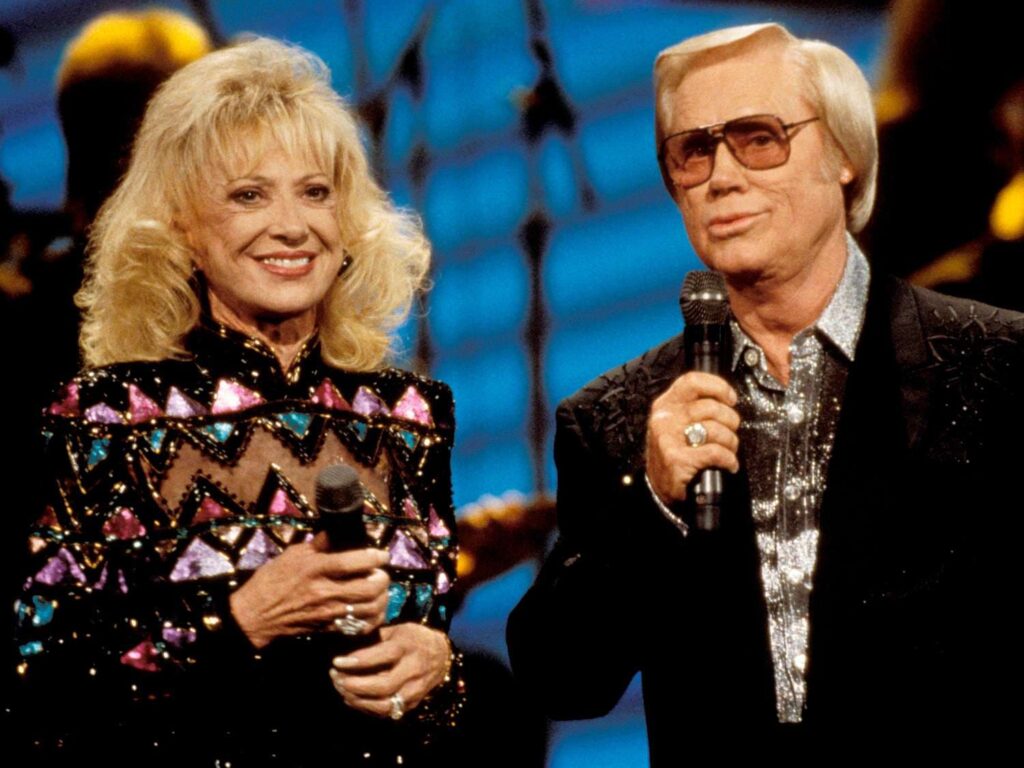
A vow of survival where love endures not through perfection, but through shared struggle
In 1973, George Jones and Tammy Wynette brought their real-life complexities into sharp musical focus with We’re Gonna Hold On, the title track of their collaborative album We’re Gonna Hold On. Released during a period when both artists were already towering figures in country music, the song resonated deeply with audiences, becoming one of their most enduring duets and a defining statement of their artistic and personal partnership.
What gives We’re Gonna Hold On its lasting gravity is the uneasy truth beneath its surface. This is not a love song built on fantasy or idealism. It is a declaration forged in adversity. By the time the song entered the public consciousness, the marriage between George Jones and Tammy Wynette was already marked by turbulence, making every line feel less like performance and more like confession. Their voices do not merely harmonize; they confront each other, lean on each other, and, at moments, seem to plead with one another.
The structure of the song is deceptively simple. A steady rhythm, uncluttered instrumentation, and a melody that leans into classic country phrasing create a framework where the emotional weight rests almost entirely on the vocal interplay. George Jones, with his aching, deeply expressive tone, carries a sense of weariness, while Tammy Wynette responds with a mixture of strength and vulnerability. Together, they create a dialogue that feels lived-in rather than written.
Lyrically, the song speaks to a kind of love rarely celebrated in popular music. This is not the beginning of romance, nor is it its triumphant resolution. Instead, it occupies the difficult middle ground, where commitment is tested daily. The repeated insistence that “we’re gonna hold on” becomes less a promise and more a necessity. It suggests that love, in its most honest form, is not sustained by passion alone but by persistence.
There is an almost documentary quality to the performance. Listeners are not positioned as passive observers but as witnesses to something intimate and unresolved. That tension between public performance and private reality is what elevates We’re Gonna Hold On beyond a standard duet. It becomes a mirror reflecting the contradictions of love itself, where devotion and doubt can exist side by side.
Within the broader landscape of country music, the song stands as a pivotal example of how the genre evolved in the early 1970s. It moved away from purely narrative storytelling toward something more autobiographical and emotionally exposed. George Jones and Tammy Wynette did not simply sing about hardship; they embodied it. Their lived experiences infused the music with a credibility that could not be manufactured.
Over time, We’re Gonna Hold On has come to represent more than just a moment in their careers. It is a testament to the fragile resilience of human connection. Even as history would reveal the eventual dissolution of their marriage, the song remains suspended in its own truth. For those few minutes, belief outweighs doubt, and the act of holding on becomes both a struggle and a form of grace.