
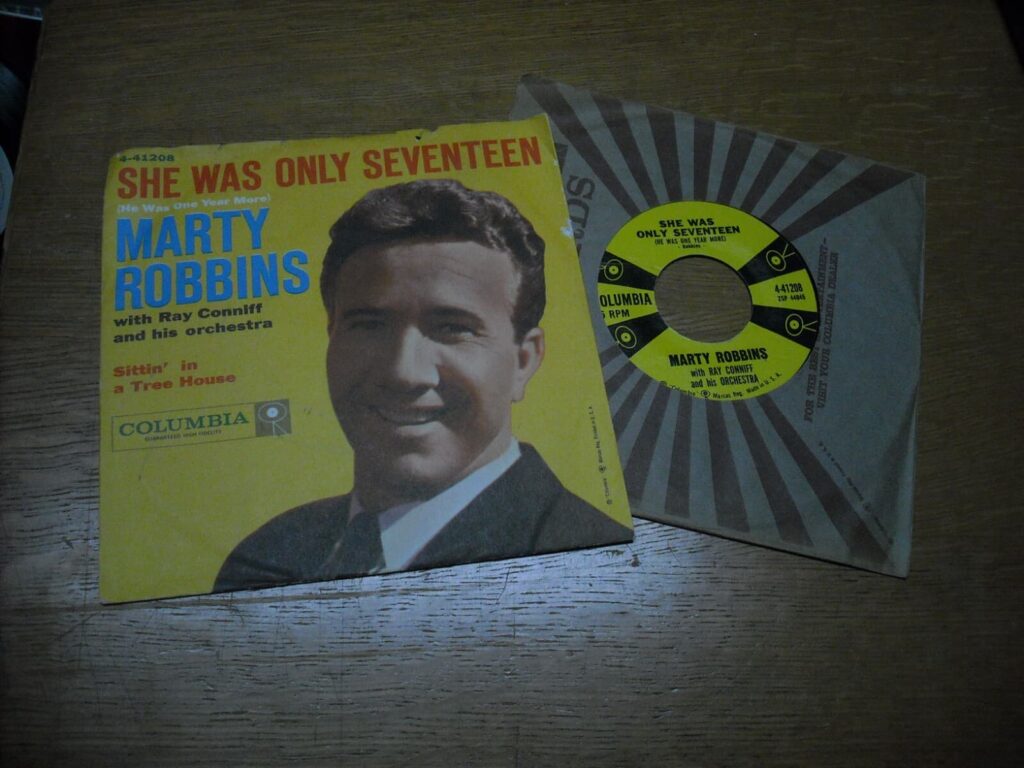
A Tender Reckoning of Youth and Love in the Midst of a Changing America
She Was Only Seventeen stands as an evocative testament to the lyrical sensitivity and crossover appeal of Marty Robbins in the late 1950s. Released as a single on July 7, 1958, on the Columbia label, Robbins’ self-penned meditation on young love climbed to No. 4 on Billboard’s Country and Western Best Seller chart and spent ten weeks in the rankings, while also reaching No. 27 on the broader Hot 100 pop chart. In Billboard’s year-end tally for 1958, the song was placed at No. 41 among country and western singles, underscoring its resonance across audiences in a year marked by seismic shifts in popular music.
In the context of Robbins’ storied career, She Was Only Seventeen occupies a unique space: it is neither the hard-nosed narrative of frontier ballads like El Paso nor the straightforward heartbreak of his pure country classics, but rather a tender vignette capturing the restless hope and social scrutiny that surrounds young lovers on the brink of adulthood. Written and recorded at the height of Robbins’ early commercial success, the song demonstrates his facility not only with sonic textures that appealed to both country and pop listeners but also with narrative nuance that treats youthful emotion with genuine empathy rather than condescension.
The lyrical heart of She Was Only Seventeen unfolds with sober clarity. Robbins frames his narrative around a youthful couple whose devotion is questioned by those around them precisely because of their age. The refrain’s focus on “seventeen” and “one year more” is deceptively simple, yet it encapsulates a broader cultural tension of the 1950s—a time when the postwar generation was redefining rites of passage and courting long-term commitment at ever younger ages. There is no glib dismissal of youthful ardor here; instead, Robbins invites listeners to weigh the authenticity of emotion against the skepticism of experience.
Musically, the arrangement balances traditional country instrumentation with an accessible sheen that hints at pop sensibilities. Robbins’ smooth vocal delivery, neither overly dramatic nor detached, lends the song an intimacy that makes it feel less like a commentary and more like a shared confidance. The involvement of arranger Ray Conniff and his orchestra—credited on the original recording—adds subtle layers of warmth, placing the narrative in a soundscape that feels both personal and expansive.
Critically, She Was Only Seventeen stands as an early example of Robbins’ ability to traverse emotional terrains that elude simple categorization. While his later work would dig deeper into mythic and cinematic storytelling, here Robbins turns his keen observational gifts toward the quotidian yet profound world of young love. The result is a song that feels timeless in its compassion, anchored in specific chart success yet enduring in its portrayal of vulnerability and hope.
In the broader sweep of Robbins’ discography, this song reminds us that his greatest strength was not merely in crafting hits but in articulating the emotional landscapes of ordinary lives with extraordinary grace.