
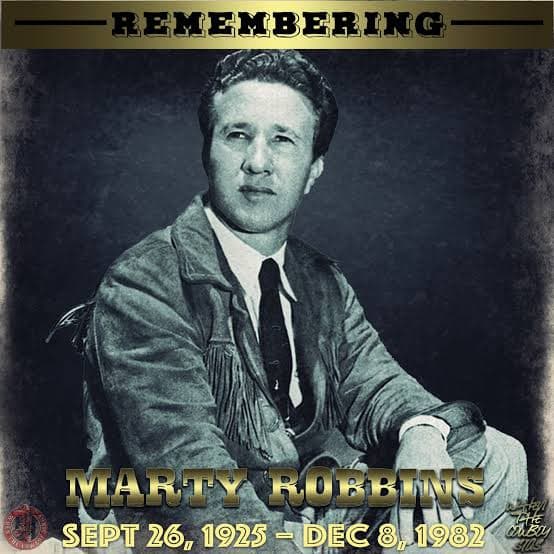
A quiet western reverie where the road becomes memory and longing does the talking.
Released by Marty Robbins during the peak of his Columbia Records years, Trail Dreamin’ arrived not as a chart driven single but as a deep album cut on The Song of Robbins, bypassing the country and pop singles charts while finding its life in the grooves cherished by devoted listeners. It stands as a reminder that Robbins’ legacy was never built solely on chart positions, but on a body of work rich enough to reward patience and repeat listening.
By the time Trail Dreamin’ was recorded, Robbins had already secured his place as one of American music’s most vivid storytellers. He was widely celebrated for grand narratives of gunfighters and doomed lovers, yet this song reveals a more introspective side of his western imagination. Here, the trail is not merely a physical path across desert or prairie. It becomes an interior landscape where memory, regret, and hope quietly intersect. Robbins does not rush the listener forward. He lets the song drift, mirroring the way a lone rider might allow a horse to choose its pace while thoughts wander freely.
Lyrically, Trail Dreamin’ speaks to the romantic solitude that defines so much of Robbins’ work. The narrator is not chasing glory or danger. Instead, he is suspended between movement and stillness, riding forward while emotionally tethered to places and people left behind. This duality has long been central to Robbins’ appeal. His protagonists often move through wide open spaces, yet carry an unmistakable sense of inward reflection. In Trail Dreamin’, that reflection becomes the song’s emotional center, evoking a man who travels not to escape memory, but to live alongside it.
Musically, the arrangement is restrained and deliberate. The gentle rhythm suggests the steady cadence of hooves on dirt, while Robbins’ vocal delivery remains calm, almost conversational. There is no theatrical flourish here, no dramatic crescendo. Instead, the power lies in understatement. Robbins sings as though he is thinking aloud, allowing silence and space to carry as much meaning as the words themselves. This approach deepens the song’s sense of authenticity, reinforcing the idea that some emotions are best expressed quietly.
Over time, Trail Dreamin’ has endured as one of those recordings that reveals its depth slowly. It does not announce itself with urgency, but it lingers. For listeners attuned to Robbins’ western ballads, the song feels like a moment of rest along the journey, a pause where the horizon stretches endlessly and the past rides alongside the present. Its cultural legacy may not be measured in chart statistics, but in its ability to capture a uniquely American solitude, one defined by open land, inward thought, and the gentle ache of remembrance.
In the canon of Marty Robbins, Trail Dreamin’ remains a subtle but essential chapter, proof that even far from the spotlight, his music continued to speak with quiet authority and lasting emotional truth.