
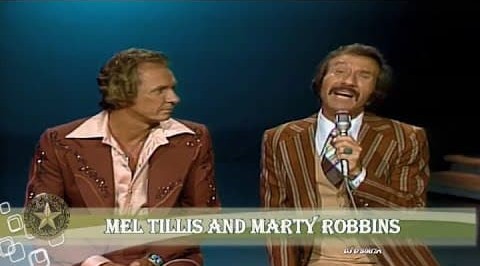
Two Masters of Country Music Meeting in the Warm Glow of Television’s Golden Honky Tonk Era
The appearance of Mickey Gilley alongside Marty Robbins on Marty Robbins Spotlight was never designed to behave like a chart-chasing single or a carefully marketed album cut. It belonged to something older and, in many ways, more enduring: the tradition of country music as conversation. By the time this televised meeting aired in the late 1970s, both men already carried towering reputations. Marty Robbins, long celebrated for landmark recordings such as “El Paso” from the album Gunfighter Ballads and Trail Songs, had become one of country music’s defining storytellers, while Mickey Gilley was ascending toward the commercial peak that would soon make him one of the signature voices of the Urban Cowboy movement. The performance itself exists less as a commercial artifact and more as a living snapshot of two eras of country music shaking hands beneath the studio lights.
What makes these appearances so fascinating decades later is not spectacle, but ease. Country television in that era often carried an intimacy modern broadcasts rarely capture. The cameras stayed close. The musicians listened to one another. Silence mattered almost as much as applause. Watching Marty Robbins host a guest like Mickey Gilley feels remarkably unguarded, as though viewers have wandered into the back room of a Nashville session after midnight, where musicians stop performing for the crowd and begin playing for each other.
The contrast between the two artists is part of the magic. Marty Robbins possessed a voice that floated with cinematic elegance. Even in casual conversation, there was a polished calmness to him, the sound of a man who understood balladry as theater. His greatest songs often unfolded like Western films compressed into three minutes: lonely deserts, doomed lovers, riders escaping fate beneath enormous skies. Mickey Gilley, by comparison, carried the pulse of the Texas honky-tonk. His piano attack, deeply influenced by his cousin Jerry Lee Lewis, brought rhythm and swagger into the room. Gilley’s records were built for neon lights, dance floors, and whiskey-colored evenings.
Yet when these two men shared a stage, the differences never clashed. They complemented one another. Robbins brought narrative grandeur. Gilley brought movement and immediacy. One sounded like the open plains of the American West; the other sounded like a crowded bar just before closing time. Together, they revealed how broad country music had become by the late 1970s without losing its emotional center.
There is also something deeply poignant about revisiting these performances now. Television preserved gestures that studio recordings could never fully capture: the sideways grin from Robbins after a clever vocal phrase, the visible admiration as he watched Gilley’s hands move across the piano keys, the relaxed banter between two men who understood the burdens of fame but still loved the craft itself. These were entertainers from a generation that believed personality mattered as much as technical perfection.
For mature listeners today, performances like this endure because they remind us that classic country music was never merely about heartbreak or nostalgia. It was about presence. About artists carrying entire lifetimes into a song with understated confidence. The meeting of Mickey Gilley and Marty Robbins on Marty Robbins Spotlight remains valuable not because it dominated radio charts, but because it captured something rarer: two masters recognizing one another in real time, preserving a fleeting moment when country music still felt handmade, conversational, and profoundly human.