
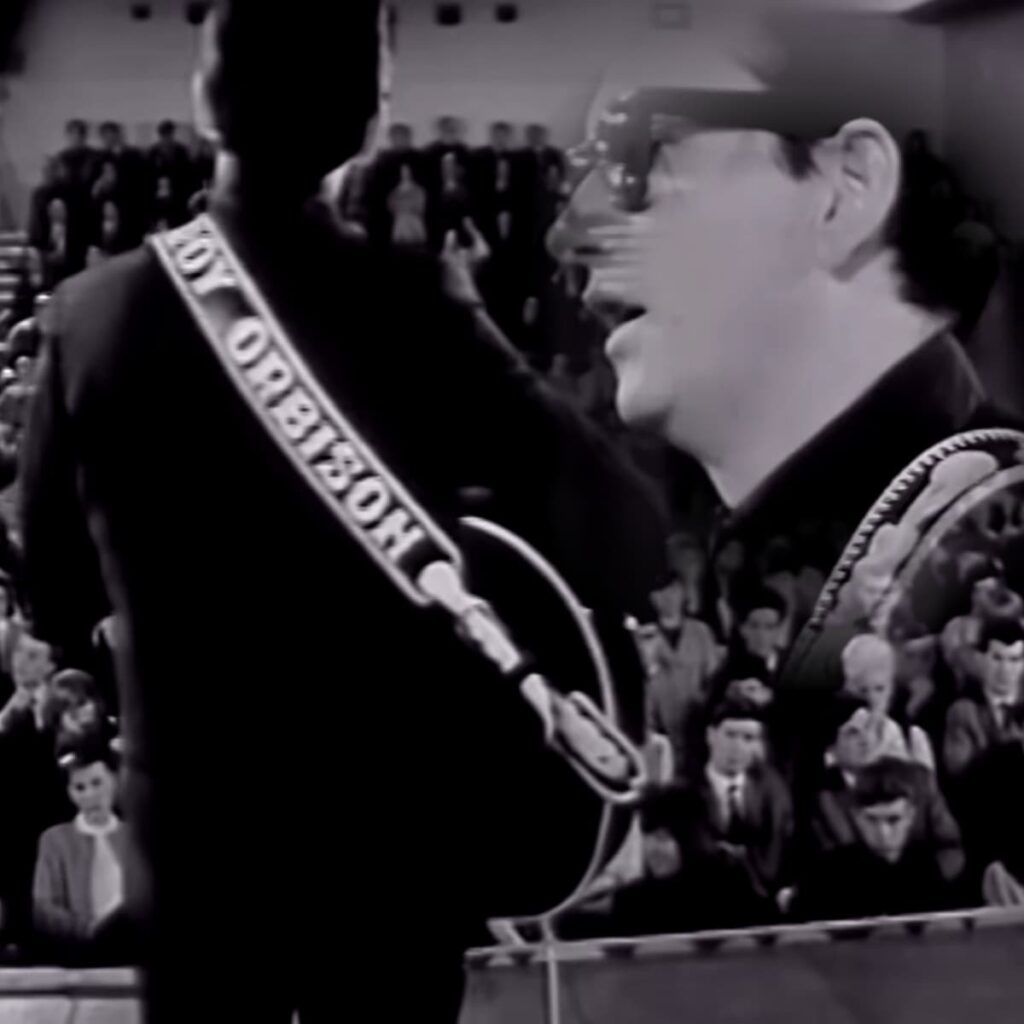
A Voice Breaking Under the Weight of Love Became One of the Most Haunting Performances of the 1960s
When Roy Orbison stepped onto the stage for Monument Concert 1965 to perform “Crying,” he was no longer merely a successful recording artist — he had become the living embodiment of heartbreak in American popular music. Originally released in 1961 on the album Crying, the single climbed to No. 2 on the Billboard Hot 100 and became one of the defining records of Orbison’s career, solidifying his reputation as a vocalist capable of transforming emotional devastation into operatic grandeur. Even amid an era crowded with giants, Roy Orbison possessed something singular: a voice that did not simply sing sorrow, but inhabited it completely.
What makes “Crying” endure is not merely its lyrical premise — a man unexpectedly encountering a former lover and pretending he has moved on — but the terrifying emotional collapse hidden beneath that restraint. Orbison understood that heartbreak is rarely explosive at first. Often, it begins with composure. The narrator smiles politely, speaks calmly, maintains dignity. Yet every line feels like a crack spreading slowly through glass. By the time the song reaches its towering climax, the emotional mask has shattered entirely.
That progression is the genius of the composition written by Roy Orbison and Joe Melson. Structurally, the song behaves almost like a dramatic aria rather than a conventional pop single. The melody rises in stages, each verse carrying greater emotional pressure until Orbison unleashes the now-legendary high notes that sound less like performance and more like surrender. Few singers in rock and roll history possessed such command over vulnerability. He could move from near-whispered intimacy to cathedral-sized anguish within seconds, and in “Crying,” he achieves perhaps the purest example of that dynamic power.
The 1965 concert rendition carries an additional emotional gravity because it captures Orbison during the peak of his international acclaim. This was the period when his dark suits, motionless stage presence, and black sunglasses had already become iconic. Yet unlike many performers of the era who relied on charisma or physicality, Orbison stood nearly still. The drama existed entirely in the voice. Watching him perform “Crying” live reveals how little theatrical embellishment he needed. Every ounce of intensity emerged naturally from phrasing, breath control, and emotional timing.
Musically, the arrangement remains astonishingly sophisticated for early-1960s pop. The sweeping strings, restrained percussion, and gradual orchestral build create an atmosphere closer to cinematic tragedy than radio-friendly rock music. Monument Records understood that Orbison’s voice was not meant to compete with instrumentation — it was meant to soar above it like a lonely signal in the night. The production gives the song an almost dreamlike loneliness, where memory and reality begin to blur together.
Over the decades, “Crying” has become more than a hit record; it has evolved into a universal language for emotional regret. Its influence can be heard across generations of singers who learned that vulnerability could be powerful rather than weak. Long before confessional songwriting became fashionable, Roy Orbison was already exposing emotional fragility with frightening honesty.
The performance from Monument Concert 1965 preserves that honesty in its purest form. It is not simply a man singing about lost love. It is the sound of dignity collapsing in real time — beautifully, painfully, and forever.