
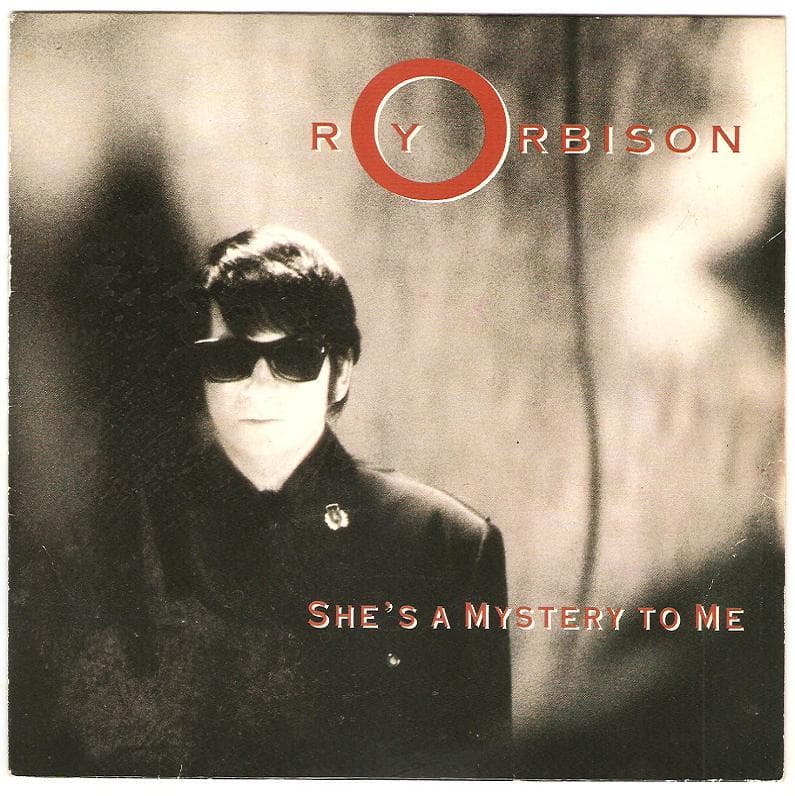
A Love So Elusive It Feels Like a Memory Slipping Through Your Hands
When Roy Orbison released “She’s a Mystery to Me” in 1989 as part of the acclaimed comeback album Mystery Girl, the song arrived not as a triumphant chart-dominating single, but as something far more enduring: a late-career confession wrapped in moonlit melancholy. While the album itself became one of Orbison’s most celebrated commercial returns—reaching the Top 5 in the United States and producing the worldwide hit “You Got It”—“She’s a Mystery to Me” quietly emerged as one of the emotional centerpieces of the record. Written by Bono and The Edge of U2 specifically for Orbison, the song feels less like an outside composition and more like it had always belonged to him, waiting decades for the right voice to carry its ache.
By the late 1980s, Orbison was no longer merely a survivor of rock and roll’s first golden age. He had become a spectral figure in American music mythology—a man whose voice carried loneliness with almost supernatural precision. His collaborations with the Traveling Wilburys had restored him to public consciousness, yet “She’s a Mystery to Me” revealed something deeper than career revival. It exposed vulnerability without disguise. The song does not plead for love in the conventional sense; instead, it stands in awe of emotional distance, of the unknowable nature of another human soul.
The genius of the composition lies in its restraint. Bono, an artist clearly shaped by Orbison’s operatic sorrow, resisted the temptation to imitate the grand melodrama of classics like “Crying” or “Only the Lonely.” Instead, he built the song around stillness and shadow. The lyrics move like fragments of midnight thought—impressions rather than declarations. “Dark and silent and complete,” Orbison sings, not as a man demanding answers, but as someone surrendering to mystery itself. There is heartbreak here, certainly, but also reverence. The woman at the center of the song is not villainized or romanticized beyond recognition. She remains beautifully unreachable.
What makes the recording extraordinary is the way Orbison’s aging voice transformed the material. In his younger years, his vocals often soared with almost impossible dramatic force, climbing into emotional heights that felt volcanic. Here, however, age had introduced fragility into the timbre. That fragility became the song’s secret weapon. Every note sounds lived-in. Every pause feels haunted by years of loss, endurance, and hard-earned grace. Orbison had endured profound personal tragedies throughout his life, and by the time he recorded Mystery Girl, his singing carried the emotional weight of someone who understood that longing does not disappear with age—it simply becomes quieter and more permanent.
The production mirrors that emotional atmosphere with remarkable elegance. Gentle guitars shimmer at the edges of the arrangement, while the rhythm section moves patiently, never intruding on the intimacy of the vocal. There is space in the recording, and that space matters. Silence becomes part of the storytelling. It allows Orbison’s voice to linger like smoke in an empty room.
In retrospect, “She’s a Mystery to Me” feels almost unbearably poignant because it became part of Orbison’s final chapter. Released shortly after his death in December 1988, the song now carries the weight of farewell even though it was never intended as one. That unintended poignancy is what elevates the recording beyond mere comeback-era nostalgia. It is the sound of an artist rediscovering emotional truth at the very end of his journey.
Many singers have performed songs about unattainable love. Few have sounded as though they truly understood the beauty and sorrow of never fully possessing it. Roy Orbison did. And in “She’s a Mystery to Me,” he turned uncertainty itself into something timeless.