
A SONG ABOUT DESIRE BECAME A MEETING OF TWO LONELY GIANTS OF AMERICAN MUSIC
When Roy Orbison stepped onto the stage of The Johnny Cash Show in 1969 to perform “Oh, Pretty Woman” alongside Johnny Cash, the moment carried far more weight than a simple television duet. By then, the song had already become one of the defining records of the 1960s. Originally released in 1964 from the album Orbisongs, “Oh, Pretty Woman” reached No. 1 on the Billboard Hot 100 and established Orbison not merely as a hitmaker, but as a singular emotional force in popular music. Yet the 1969 performance arrived during a very different chapter in his life and career, transforming the song from youthful swagger into something far more layered and human.
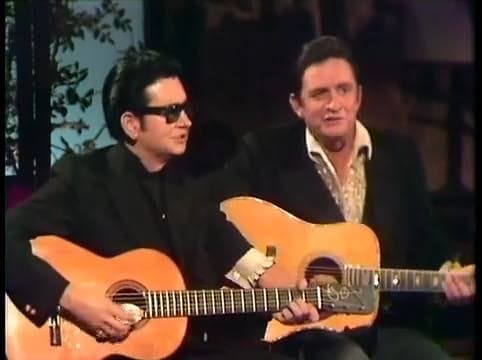
What makes this performance remarkable is not spectacle, but contrast. Johnny Cash stood grounded and rugged, carrying the weathered authority of country music’s wandering philosopher. Beside him was Roy Orbison, dressed in black, hidden behind dark glasses, almost motionless as he sang. Together, they represented two different kinds of American loneliness. Cash sang like a man wrestling with the outside world. Orbison sang like a man trapped inside himself.
By 1969, Orbison had already endured devastating personal tragedy. The deaths of his wife Claudette in 1966 and two of his sons in a house fire in 1968 had altered the emotional gravity surrounding him forever. Even when he sang an upbeat classic like “Oh, Pretty Woman,” audiences could no longer hear it as simple rock-and-roll flirtation. There was now an ache beneath the rhythm, a strange duality that had always existed in Orbison’s voice but became impossible to ignore after loss entered his life so publicly.
That is why this live rendition feels different from the original hit single. The famous opening guitar line still arrives with confidence, and the melody still carries its irresistible movement, but Orbison’s delivery in 1969 possesses something quieter and more haunting. He does not chase the audience’s attention. He barely moves at all. Instead, he lets the voice do the work, rising from tenderness into operatic force with the same emotional precision that made him unlike anyone else in rock music.
The genius of “Oh, Pretty Woman” has often been misunderstood because of its commercial success. Beneath the catchy rhythm and playful lyrics lies a song about distance and longing. The narrator is not triumphant. He is uncertain. He watches someone beautiful pass by and immediately assumes she belongs to another world. Orbison always specialized in characters who stood outside happiness looking in. Even in his biggest hit, there is vulnerability hidden beneath desire.
On The Johnny Cash Show, that vulnerability became more visible than ever. Cash understood it instinctively. His admiration for Orbison was genuine, rooted in the knowledge that few singers could communicate heartbreak with such elegance and restraint. The performance therefore feels less like a television booking and more like a gathering of survivors from an era when popular music still allowed men to sound emotionally exposed without irony.
More than half a century later, the recording endures because it captures two legends at a crossroads. One was rebuilding himself through music after unimaginable grief. The other was becoming the voice of American redemption and endurance. Together, they turned “Oh, Pretty Woman” into something larger than a hit record. It became proof that even songs born from youthful energy can mature into reflections on memory, pain, and resilience when carried by voices that have truly lived.