
A final gathering of voices where legacy is not remembered, but lived in the presence of those who understand it best
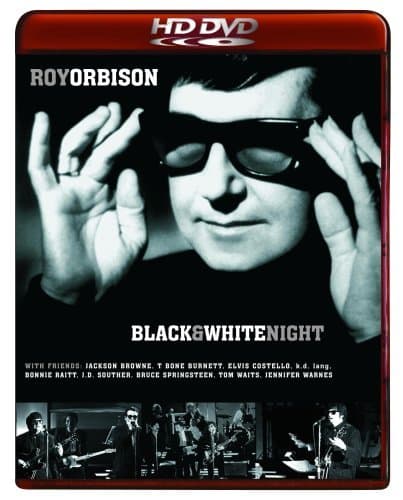
In 1988, Roy Orbison stood at the center of an extraordinary moment captured in Roy Orbison & Friends: A Black and White Night, a televised concert later released as an album that would achieve significant commercial success and critical acclaim. The performance, recorded at the Cocoanut Grove in Los Angeles, arrived during a remarkable late-career resurgence for Orbison, shortly before the release of Mystery Girl. While not a conventional studio album, this live event became one of the defining documents of his legacy, reaffirming his stature through the company he kept and the reverence with which his music was received.
The premise of the concert is deceptively simple. Roy Orbison, dressed in black, standing almost motionless, delivering songs that had already etched themselves into the fabric of popular music. Yet surrounding him is a carefully assembled ensemble of peers and admirers, including figures such as Bruce Springsteen, Elvis Costello, and Tom Waits. Their presence is not ornamental. It is declarative. Each artist, in their own way, acknowledges Orbison not merely as a contemporary, but as a foundational influence.
What unfolds across Roy Orbison & Friends: A Black and White Night is less a performance than a communion. The songs, many of them drawn from his most iconic repertoire, are not reimagined for novelty. They are reaffirmed. When Orbison sings, the room does not compete with him. It yields. His voice, unchanged in its haunting clarity, rises with a controlled intensity that feels almost untouched by time. The famed crescendos remain, but what resonates most is the precision. The ability to hold emotion in suspension before releasing it with quiet inevitability.
The black-and-white presentation adds another layer of meaning. Stripped of color, the performance becomes timeless, detached from the era in which it was recorded. This aesthetic choice mirrors Orbison’s music itself, which has always resisted confinement to a specific period. The absence of visual distraction directs attention to the essentials. Voice, melody, and presence.
There is a profound contrast at the heart of this concert. Roy Orbison, an artist often associated with solitude and introspection, is here surrounded by others. Yet he remains singular. The supporting musicians and vocalists, despite their own stature, never overshadow him. Instead, they create a framework within which his artistry can be fully realized. It is a rare dynamic, one built on respect rather than rivalry.
Beyond the technical excellence, the performance carries an undercurrent of quiet poignancy. There is an awareness, though unspoken, that this moment represents something more than a return. It is a culmination. A recognition of a career that had weathered both immense success and profound personal hardship. In this setting, those experiences seem to converge, giving the songs an added depth.
What makes Roy Orbison & Friends: A Black and White Night endure is not simply the quality of the music, but the atmosphere it creates. It captures an artist not reclaiming his place, but reaffirming it. There is no sense of struggle, no need to prove relevance. Only the presence of a voice that has already earned its place in history.
And as the final notes fade, what remains is not just the memory of a performance, but the feeling of having witnessed something definitive. A moment where past and present meet, and where Roy Orbison, surrounded yet unmistakably alone in his artistry, reminds the world exactly who he is.