
A Heart Suspended Between Fear and Love Until a Single Moment Changes Everything
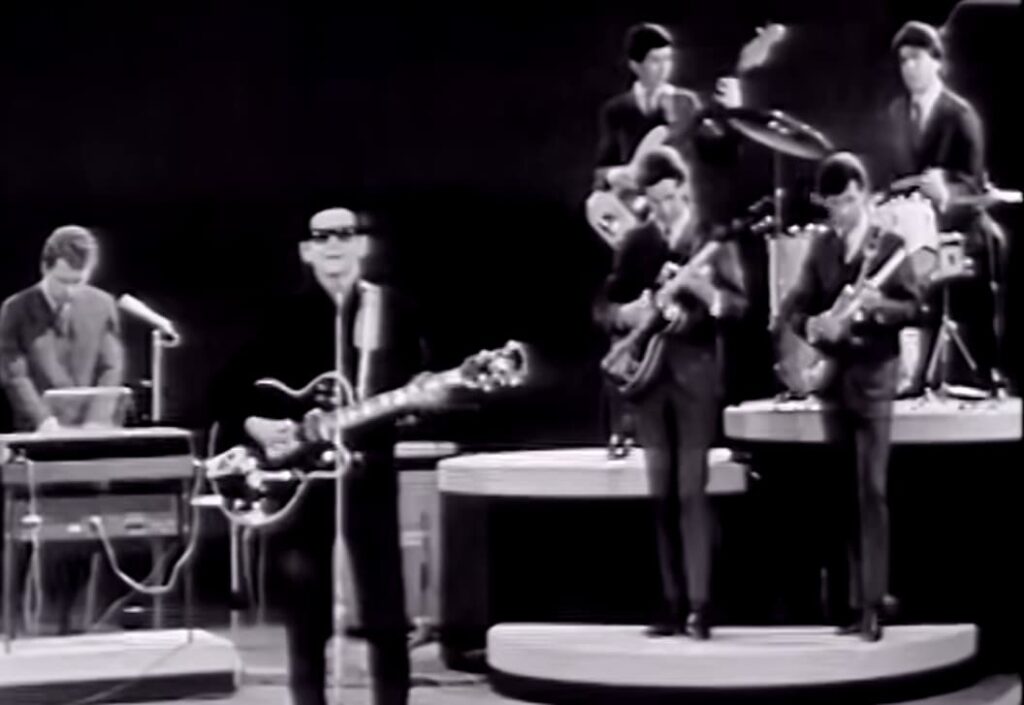
Few songs in popular music capture emotional tension with the elegance and precision of “Running Scared” by Roy Orbison. Originally released in 1961 and later included on the landmark album Crying, the song became Orbison’s first No. 1 hit on the Billboard Hot 100, spending a week atop the American charts while helping establish him as one of the most distinctive voices of the rock-and-roll era. The performance featured in the 1965 Monument Concert preserves that achievement in a live setting, revealing just how naturally Orbison could recreate its emotional intensity on stage.
What makes “Running Scared” remarkable is not merely its commercial success but its unusual structure. At a time when pop songs depended heavily on memorable choruses and repetitive hooks, Orbison and songwriting partner Joe Melson crafted something entirely different. The song unfolds like a miniature drama, moving steadily forward without a traditional chorus, each verse adding another layer of anxiety and anticipation.
The narrative itself is deceptively simple. A man fears that the former lover of the woman he adores may return and reclaim her. Yet beneath that straightforward premise lies a profound exploration of insecurity. The protagonist is not battling an external rival so much as confronting his own doubts. Every line feels like an internal conversation, every moment shadowed by the possibility of loss. Orbison understood that some of the most painful struggles occur not in public confrontations but in the private spaces of the mind, where fear can grow larger than reality.
Musically, the recording mirrors this emotional journey with extraordinary craftsmanship. The arrangement begins quietly, almost cautiously, as though afraid to reveal too much. With each passing measure, the tension tightens. The orchestra rises, the rhythm presses forward, and Orbison’s voice climbs higher and higher. There is no release until the final seconds. Then comes one of the most celebrated climaxes in popular music: a soaring vocal ascent that transforms anxiety into triumph. The song resolves not with a dramatic confrontation but with a single revelation—the woman chooses to stay.
Listening to the 1965 live performance, one is reminded why Roy Orbison stood apart from nearly every contemporary singer of his generation. While many rock-and-roll stars projected confidence, rebellion, or swagger, Orbison embraced vulnerability. He sang about heartbreak, uncertainty, longing, and emotional fragility without sacrificing strength. His voice could sound wounded and powerful at the same time, a rare combination that gave songs like “Running Scared” their enduring impact.
More than six decades after its release, “Running Scared” remains a masterclass in musical storytelling. It demonstrates how a song lasting barely two minutes can feel as dramatic as an opera, building suspense with relentless precision before delivering one of the most satisfying emotional resolutions in the history of popular music. In the hands of Roy Orbison, fear becomes poetry, and a simple love story becomes unforgettable.