
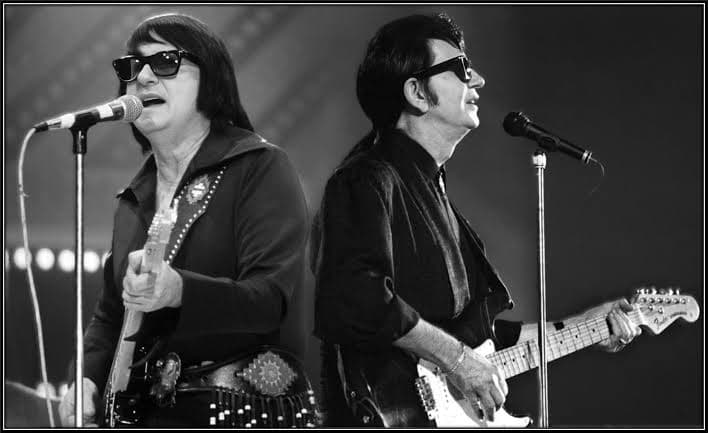
A Night When Grief Became Celebration and a Legend’s Voice Echoed Through Others
Released not as a conventional studio recording but as a televised concert event, “Roy Orbison Tribute Highlights, February 24, 1990” captures the emotional center of a remarkable evening held at Los Angeles’ Universal Amphitheatre in honor of Roy Orbison, whose death in December 1988 left one of popular music’s most singular voices suddenly silent. Organized by Orbison’s widow, Barbara Orbison, the benefit concert brought together an extraordinary gathering of artists to celebrate his life, music, and enduring influence. Rather than belonging to a traditional album with chart ambitions, this performance document stands as a living testament to the reach of Orbison’s artistry and the reverence he inspired among his peers.
What makes this tribute so compelling is that it never feels like a memorial weighed down by sorrow. Instead, it reveals how deeply Orbison’s songs had entered the emotional vocabulary of popular music. Throughout the evening, performers from vastly different musical worlds—rock, country, blues, folk, and pop—found common ground in compositions that spoke the universal language of longing, heartbreak, vulnerability, and hope. The roster itself reads like a hall of fame: k.d. lang, B.B. King, Bonnie Raitt, Emmylou Harris, John Hiatt, The Byrds, and even surprise appearances from figures such as Bob Dylan helped transform the concert into an affirmation of Orbison’s place among the giants of twentieth-century music.
The performances highlighted in this collection illuminate a truth that had always set Orbison apart. While many rock-and-roll stars projected confidence and rebellion, Orbison embraced emotional exposure. Songs such as “Crying,” “Only the Lonely,” and “Oh, Pretty Woman” carried operatic drama without sacrificing intimacy. His voice seemed capable of turning private heartbreak into something monumental. That quality echoes throughout the tribute. When k.d. lang delivers “Crying,” or when the assembled performers join together for the evening’s finale, the songs cease to belong solely to Orbison and become part of a shared musical inheritance.
There is also a poignant historical resonance to the event. Coming just months after Orbison’s late-career renaissance with the Traveling Wilburys and the posthumous success of “You Got It,” the concert serves as a reminder that his influence was not confined to the early rock era. Younger artists, veteran contemporaries, and musical innovators alike recognized in Orbison a rare figure whose work transcended generations. The tribute demonstrates that his legacy was never merely a collection of hit records; it was an emotional blueprint for how popular music could express loneliness, desire, and resilience with honesty and grandeur.
Listening to these highlights today, one hears more than a succession of performances. One hears an entire community of musicians gathering around the memory of a man often called “The Big O,” repaying a creative debt through song. The result is not simply a tribute concert—it is a portrait of artistic immortality, proving that while Roy Orbison’s voice may have fallen silent, the feelings he gave shape to continue to resonate through every artist brave enough to sing from the heart.