
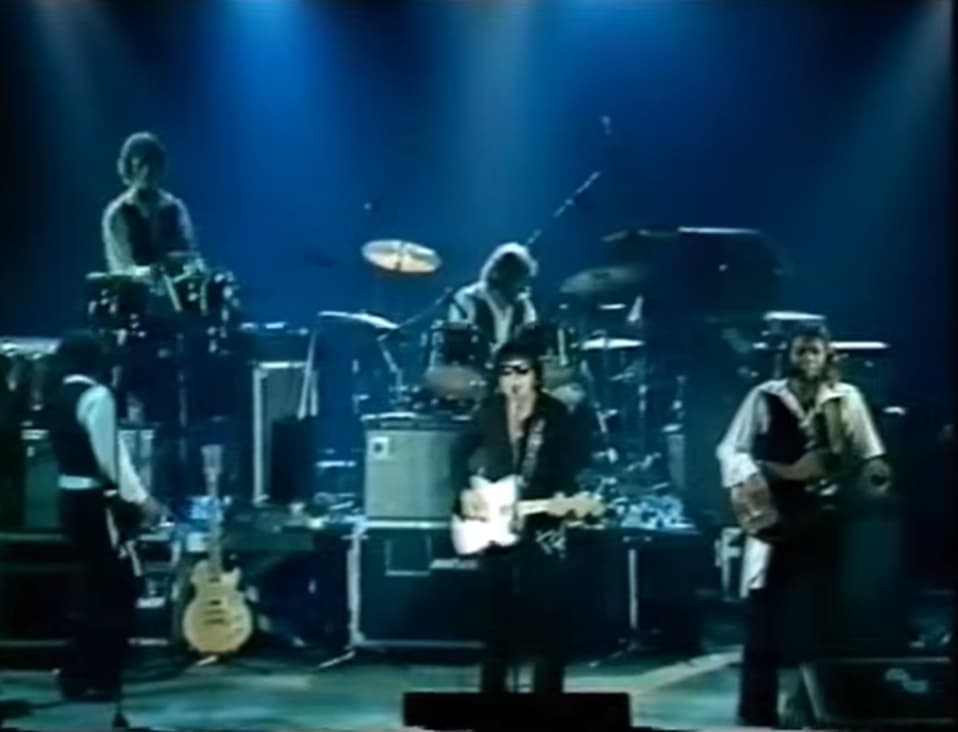
A Voice Beyond Time, Captured in a Moment of Unfading Grace
Released as a concert performance rather than a conventional charting single, “ROY ORBISON – LIVE FROM ROOSENDAAL, THE NETHERLANDS (FULL VIDEO) Dec-13-1980” preserves Roy Orbison at a fascinating point in his career. By December 1980, Orbison was already revered for the monumental body of work he had created throughout the 1960s, including the timeless recordings collected across landmark albums such as Crying, In Dreams, and The Lonely and Blue. While this Dutch concert is not associated with a specific chart position in the way one of his classic singles might be, it stands as an invaluable document of an artist whose influence had long outgrown the limitations of commercial rankings. What remains here is something more enduring: the living presence of one of popular music’s most distinctive voices.
Watching Orbison perform in Roosendaal is to witness an artist who never relied on spectacle to command a room. There are no elaborate theatrics, no restless attempts to chase contemporary trends. Instead, there is the quiet authority of a performer who understood that emotional truth was the most powerful instrument a singer could possess. Standing beneath the lights with his trademark dark glasses, Orbison appears almost motionless at times, yet every note carries extraordinary dramatic weight. The effect is mesmerizing. He does not simply sing songs; he inhabits them.
What makes this performance especially compelling is how clearly it reveals the qualities that separated Orbison from nearly every other vocalist of his era. His music occupied a unique territory between rock and roll, country, operatic drama, and pop balladry. The songs move through longing, heartbreak, devotion, and vulnerability with a cinematic sense of scale. Even decades after their creation, they retain the ability to feel intensely personal. Orbison’s voice rises from a tender whisper to soaring emotional peaks, creating the sensation that each song is unfolding as a private confession delivered to an audience of thousands.
The Roosendaal concert also serves as a reminder of Orbison’s remarkable resilience. By 1980, popular music had undergone multiple revolutions since his earliest successes. Yet his artistry remained untouched by fashion. Rather than sounding dated, his performances carried a timeless quality, rooted in universal emotions that never lose their relevance. Themes of loneliness, desire, memory, and hope resonate throughout the set, connecting listeners not to a particular moment in musical history but to the enduring realities of the human experience.
Perhaps that is the lasting significance of this recording. It captures Roy Orbison not as a nostalgic figure from the past, but as a living artist fully capable of moving an audience through the sheer power of expression. The concert stands as a testament to a rare gift: the ability to transform sorrow into beauty and vulnerability into strength. More than four decades later, this performance remains a poignant reminder that great music does not age—it simply waits for new ears to discover its truth.