
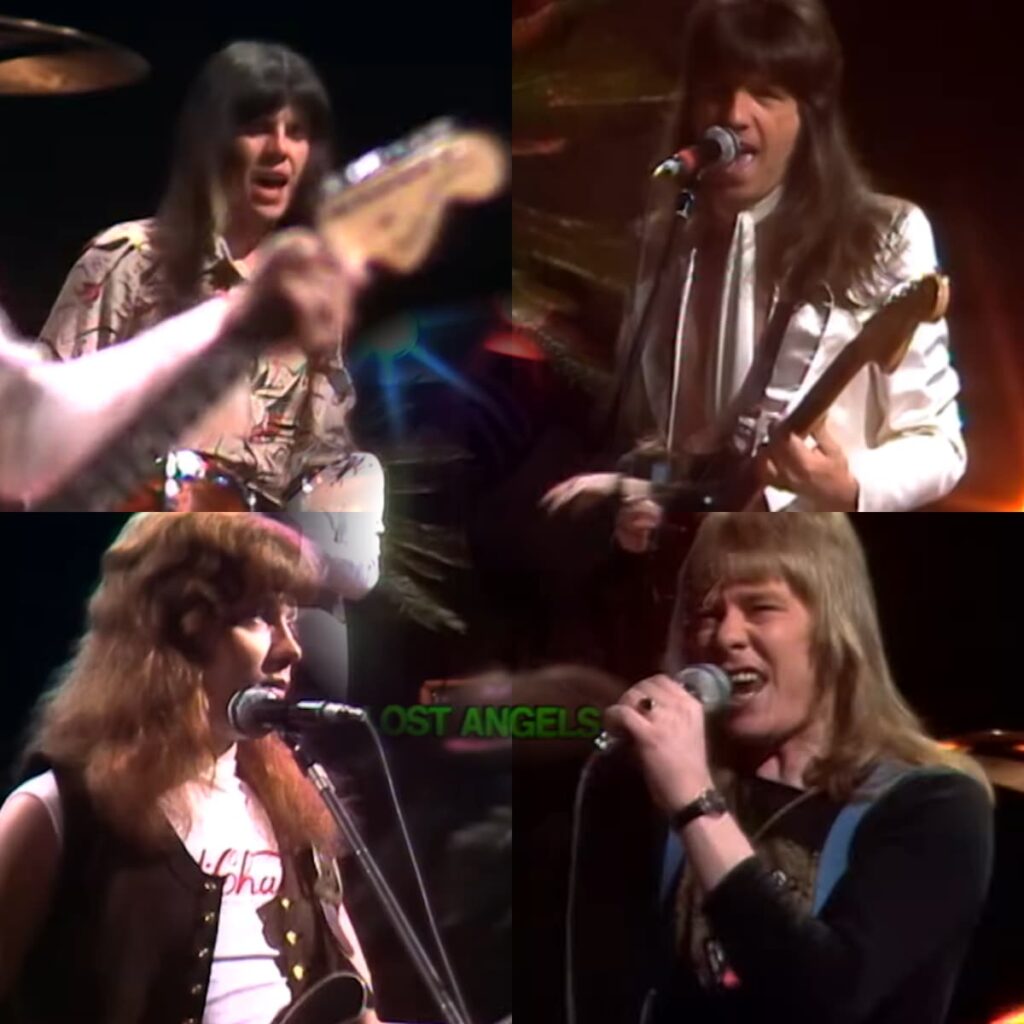
A Cry from the Edge of Fame, Where Dreamers Become the Lost Angels They Once Sought
By late 1976, Sweet were no longer merely the glitter-drenched architects of glam rock exuberance. They had entered a more introspective chapter—one marked by artistic ambition, emotional complexity, and a desire to be recognized beyond the hit-making machinery that had first brought them fame. It was in this atmosphere that “Lost Angels” emerged, released as a single in September 1976 before later appearing on the band’s 1977 album Off the Record. The song achieved notable chart success in several European territories, reaching No. 5 in Sweden, No. 13 in Germany, and No. 11 in Austria, proving that Sweet’s evolving sound still resonated deeply with audiences.
Listening to “Lost Angels” today feels like opening a weathered diary from a band standing at a crossroads. Gone is much of the carefree swagger that characterized classics such as Ballroom Blitz or Fox on the Run. In its place is a song filled with uncertainty, longing, and spiritual exhaustion. The lyrics drift through images of isolation, fractured identity, and emotional survival. The recurring plea—lost angels seeking control and direction—suggests figures caught between dreams and reality, suspended between the promise of redemption and the weight of disillusionment.
What makes the song particularly compelling is its ambiguity. The “lost angels” can be interpreted in many ways: fallen dreamers, exhausted musicians, outsiders searching for belonging, or simply human beings struggling to navigate an increasingly confusing world. Rather than offering easy answers, Sweet allow the listener to inhabit that uncertainty. The song’s emotional power lies precisely in its refusal to resolve the tension it creates.
Musically, “Lost Angels” reflects the band’s growing sophistication. Written collectively by Brian Connolly, Andy Scott, Steve Priest, and Mick Tucker, it combines dramatic vocal harmonies with heavier guitar textures and dynamic shifts that move beyond traditional glam rock formulas. The arrangement feels cinematic, almost theatrical, yet it never loses its emotional intimacy. Each section seems to mirror the psychological journey unfolding within the lyrics—a battle between despair and perseverance.
The famous Musikladen performance from December 1976 captures this transition perfectly. Here, Sweet appear less like pop idols and more like a seasoned rock band intent on proving their artistic depth. There is a seriousness in the performance, a sense that they understood this material represented something important. The song becomes more than a single; it becomes a statement of identity.
Viewed within the broader legacy of Sweet, “Lost Angels” stands as one of their most emotionally revealing recordings. It may never have attained the universal recognition of their biggest hits, but its enduring appeal lies elsewhere. It speaks to those moments when success feels hollow, when certainty fades, and when the only way forward is to keep holding on. Nearly five decades later, its message remains hauntingly relevant: even the brightest stars can lose their way, and sometimes the most powerful music is born from that very search for direction.