
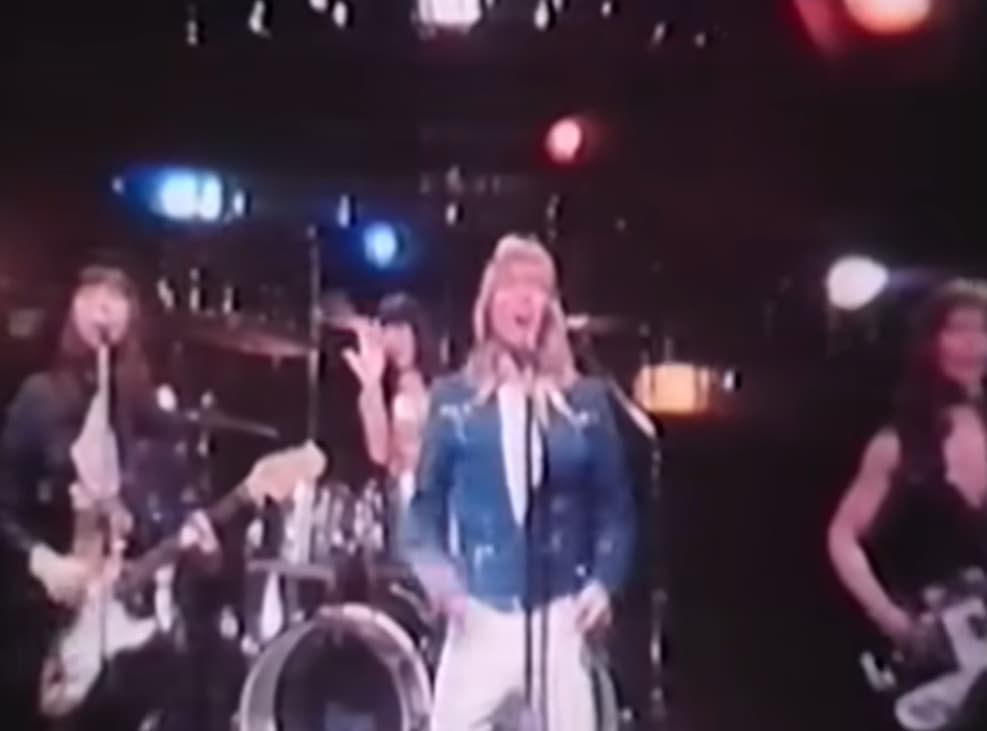
A triumphant anthem of independence, “Fox On The Run” captures the exhilarating moment when freedom becomes more irresistible than fame itself.
Released in 1975, “Fox On The Run” became one of Sweet‘s defining international hits, reaching No. 2 on the UK Singles Chart while climbing into the Top 5 across numerous countries, including a strong showing on the US Billboard Hot 100. The song was later included on the band’s album Give Us a Wink, although it had already established itself as a standalone success before appearing on the record in some markets. More than another glam rock chart-topper, “Fox On The Run” marked a pivotal chapter in Sweet‘s artistic evolution—a declaration that the band could craft and produce a major hit on their own, free from the songwriting partnership that had largely shaped their earlier commercial triumphs.
That creative independence is inseparable from the song’s enduring appeal. By the mid-1970s, Sweet had become synonymous with glittering costumes, towering harmonies, and irresistibly catchy singles. Yet behind the polished image was a group increasingly determined to prove its musicianship. “Fox On The Run” emerged from that desire. Written by band members Brian Connolly, Steve Priest, Andy Scott, and Mick Tucker, and produced by the band themselves, it represented a conscious step toward artistic control. Rather than abandoning the infectious hooks that had made them famous, Sweet refined them, wrapping shimmering synthesizers, layered vocal harmonies, and crunching guitar riffs into a record that sounded both unmistakably commercial and unmistakably their own.
Lyrically, “Fox On The Run” is often mistaken for a simple tale of romantic pursuit, but its emotional landscape is more nuanced. The “fox” of the title is less a villain than an elusive symbol—someone forever in motion, dazzling yet ultimately unattainable. She exists in a world illuminated by cameras, bright lights, and fleeting encounters, where glamour masks loneliness and attraction is complicated by distance. The narrator is captivated, yet increasingly aware that the chase itself may be more intoxicating than any possibility of genuine connection. That tension between desire and disillusionment gives the song a depth that extends well beyond its buoyant melody.
Musically, the recording remains a masterclass in glam rock craftsmanship. The instantly recognizable synthesizer introduction announces a song that embraces modern studio technology without sacrificing the raw energy of rock instrumentation. Beneath the sparkling production lies an engine driven by muscular rhythm guitars, dynamic drumming, and vocal arrangements that alternate between swagger and vulnerability. Every element serves the momentum of the record, creating a sense of perpetual forward motion that mirrors the restless character at the center of the narrative.
Decades later, “Fox On The Run” continues to occupy a special place in the history of 1970s rock because it encapsulates a moment when commercial success and artistic self-determination converged. It remains a staple of classic rock radio, film soundtracks, and nostalgic retrospectives, not simply because of its unforgettable chorus, but because it captures the intoxicating contradictions of the glam era itself. Behind its glittering exterior lies a story of musicians claiming their creative identity, transforming a chart-topping single into a lasting statement of confidence. In every soaring harmony and every driving riff, “Fox On The Run” reminds listeners that the greatest pursuit is often not another person, but the freedom to define one’s own voice.