
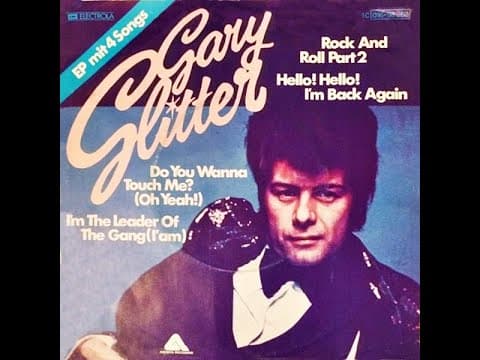
A pulse of raw electricity that captures the primal thrill of rock music reducing expression to rhythm, movement, and sheer physical charge.
Released in 1972 on the album Glitter, Rock ‘N’ Roll (Part 2) became one of the most unmistakable instrumental anthems of its era. Performed by Gary Glitter, the track surged to number 2 on the UK Singles Chart and climbed to number 7 on the Billboard Hot 100, securing its place as one of the most commercially successful glam rock records of the decade. Its chart success was only the beginning. The song quickly transformed from a simple studio creation into a cultural force, echoing through arenas and stadiums long after its release and becoming one of the most recognizable chants in popular music.
What gives Rock ‘N’ Roll (Part 2) its lasting charge is not lyrical storytelling or melodic intricacy but the deliberate absence of both. Its design strips rock music to its bare essentials. A pounding drum pattern, a grinding guitar figure, and a series of shouted vocalizations become the entire narrative. The track resists interpretation because it never intended to be interpreted. Instead, it asks to be felt. The absence of a traditional verse and chorus frees the listener to immerse themselves in rhythm and repetition, allowing the music to bypass conscious thought and ignite something instinctive.
The song’s creation emerged from the broader glam rock movement that valued theatricality, spectacle, and an almost tribal sense of unity between performer and crowd. Rock ‘N’ Roll (Part 2) embodies that ethos through its minimalist structure. The instrumentation turns into a rallying engine. Each beat moves with the weight of a marching procession, and each vocalized cheer lands like an invitation to join the collective pulse. It feels built for shared experience. Even when heard alone, the music conjures the image of thousands rising to their feet at once.
Its emotional impact comes not from personal vulnerability or narrative expression but from the elemental pleasure of sound itself. The track celebrates rock without language. It is a reminder that before rock music became a vessel for confession, social commentary, or rebellion, it existed simply to make bodies move and hearts race. In this way, Rock ‘N’ Roll (Part 2) stands as a distillation of a musical era defined by glittering surfaces and heavy backbeats. It endures because the human impulse at its core has never faded.