
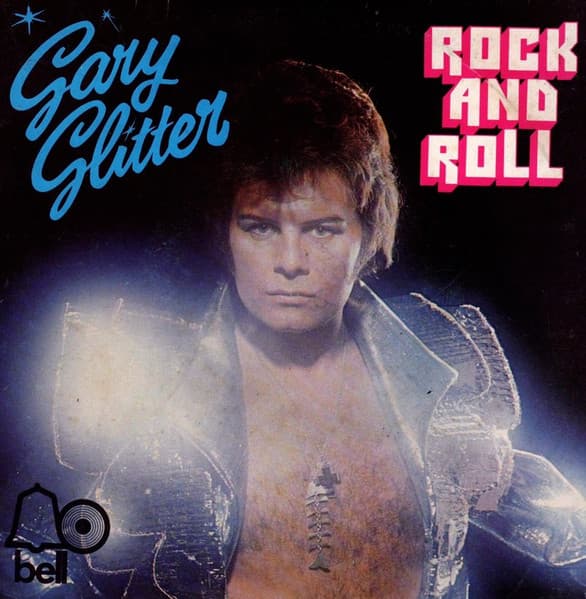
The primal roar of youth reclaiming rock’s birthright
When Rock ‘N’ Roll (Part 1) thundered into the airwaves in 1972, it marked the explosive arrival of Gary Glitter on the global stage. Issued as the lead single from his debut album Glitter, the track soared to No. 2 on the UK Singles Chart — its raw energy and anthem-like chorus immediately making it a fixture in dance halls and discotheques.
From the first percussive stomp to the chant-driven chorus, Rock ‘N’ Roll (Part 1) served as a manifesto: here was music meant not for introspective contemplation but for movement, collective release, and the visceral celebration of rock’s primal roots.
The making of the anthem: a backbeat born from spontaneity
The genesis of “Rock ’N’ Roll” was, in many ways, accidental. According to accounts of its creation, studio time slated for another artist went unused — and in that void, Glitter and his collaborator-producer Mike Leander seized the moment. With Leander supplying the instruments and Glitter layering in handclaps, stomps, chants, and vocal hooks, the session morphed into an impromptu jam that eventually stretched fifteen minutes. That raw, organic energy was later trimmed into the twin tracks now known as “Part 1” and “Part 2.”
The construction of the song hinges on simplicity: pounding drums, a gritty guitar riff, hand-claps, stomping rhythms, and the kind of communal chants that demand participation rather than passive listening. Where many rock songs of the early 1970s strived for lyrical subtlety, narrative complexity, or musical virtuosity, this track declared itself against such ambition. It was rock as you might feel it in your bones — physical, immediate, compelling in its repetition and momentum.
Leander’s production gives the track its signature stomp-and-chant character. The drums hit with the weight of marching feet; the guitars grind low, buoyed by the handclaps and Glitter’s shout-yodel vocal delivery. The effect is tribal, relentless, and communal — a sonic hammer poised to crack open dance floors and stadiums alike.
More than nostalgia: a celebration of rock’s communal heartbeat
Lyrically, “Part 1” evokes the early heritage of rock ‘n’ roll: images of sock hops, jukeboxes, and neon-lit dance halls. It calls to mind a time when rock was young and raw — when it was a communal heartbeat more than a commercial product. The repeated chorus “Rock and roll, rock, rock and roll” becomes incantatory, less about storytelling than about invoking an atmosphere, a shared ritual of release and rebellion.
In that sense, the song is a love letter to rock’s origins — not as a backward-looking homage, but as a reawakening. It recognizes rock’s power to unify, to stir, to make bodies move in unison, to create community in rhythm. For a generation caught between the idealism of the 1960s and the uncertainty of the 1970s, Glitter’s anthem offered a way out of hesitation: Here was rock reduced to its purest form — beat, shout, stomp, repetition — and it demanded only one thing of you: to succumb to the energy.
Legacy, contradiction, and the fading echo of a glittering era
The impact of Rock ‘N’ Roll (Part 1) — along with its counterpart, Part 2 — was immediate and far-reaching. It helped define the sound that came to be labeled the “Glitter Beat,” a stomping, chant-heavy style that became the hallmark of Glitter’s early career and helped him dominate the charts through the early to mid-1970s.
Yet, in the decades since, the legacy of the song has become entangled in moral and cultural contradictions. The same song that once evoked communal euphoria in dance halls and stadiums has become deeply problematic — a reminder of a figure whose personal actions irrevocably tainted his art. To engage with the music now is to confront that dissonance: can one separate the visceral joy of a beat and a shout from the person behind it? Many listeners, critics, and institutions have answered — and continue to answer — that question differently.
For those who approach the track purely as a cultural artifact, Rock ‘N’ Roll (Part 1) remains a powerful distillation of what rock can do at its most elemental: unify bodies, electrify crowds, summon a shared pulse. But it also stands as a cautionary reminder that art and artist can cast very different shadows.
In its time, Rock ‘N’ Roll (Part 1) was a declaration — of youth, of freedom, of rock’s capacity to shake the world loose from its hinges. As the needle lifts off the vinyl now, that declaration echoes differently, colored by memory, by context, by what came after. Yet as long as one listens with open ears and eyes wide, there is still a pulse beneath the glitter: crude, powerful, seductive — and irrevocably part of rock’s complex history.