
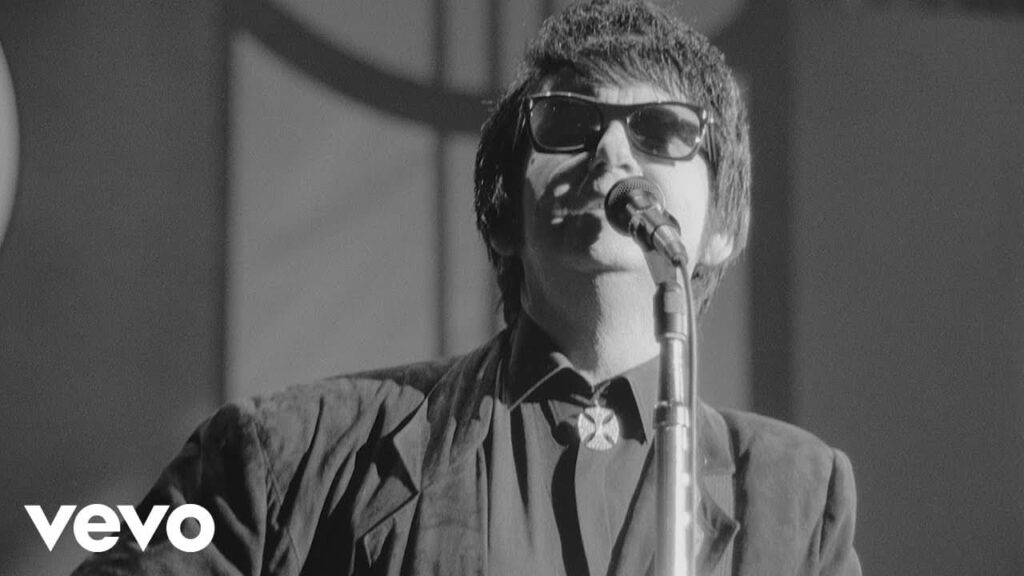
A man standing alone in the quiet after love, holding nothing but the fragile refuge of dreams
Within the luminous catalogue of Roy Orbison, the song (All I Can Do Is) Dream You occupies a poignant corner of his late-career renaissance. Performed with haunting grace during the celebrated Black & White Night reunion concerts and associated with the creative period surrounding his comeback album Mystery Girl, the song reflects the extraordinary resurgence of an artist whose voice had already shaped decades of popular music. Though not a chart-dominating single upon release, its power lies less in statistics and more in atmosphere, revealing a mature Orbison whose emotional vocabulary had only deepened with time.
To understand (All I Can Do Is) Dream You, one must first appreciate the remarkable context of Orbison’s return to prominence during the late 1980s. After years in which commercial success had fluctuated, the singer found himself at the center of a quiet revival. The world had not forgotten the man behind Only the Lonely and Crying. Instead, a new generation of musicians and listeners began rediscovering the singular beauty of his voice. The Black & White Night performance symbolized this rebirth, gathering an extraordinary ensemble of admirers and collaborators around Orbison as he revisited his legacy and unveiled newer material.
At the heart of (All I Can Do Is) Dream You lies a lyrical theme that has always defined Orbison’s artistry: longing suspended between hope and heartbreak. Few singers in the history of popular music have been able to embody romantic yearning with such unguarded sincerity. His voice, simultaneously powerful and fragile, transforms the song’s central premise into something almost cinematic. The narrator is left in the aftermath of love, stripped of certainty, yet unwilling to relinquish the emotional connection entirely. Dreams become the last refuge of devotion.
Musically, the composition echoes the classic Orbison architecture. Gentle verses gradually expand toward emotional crescendos, carried by that unmistakable tenor which could glide from a whisper to an operatic cry. Even in live performance, the arrangement remains disciplined, allowing the voice to remain the focal point. This restraint is essential. Orbison never required elaborate spectacle to command attention; the sheer expressive range of his singing accomplished that task with quiet authority.
The Black & White Night interpretation further elevates the song’s emotional gravity. The concert itself possessed an atmosphere of reverence. Surrounded by fellow musicians who had grown up inspired by his recordings, Roy Orbison stood at the center of the stage like a living monument to an earlier era of rock and roll. Yet there was nothing nostalgic about the performance. Instead, it revealed an artist fully present in the moment, singing not as a relic of the past but as a master storyteller still discovering new shades of emotion.
What ultimately gives (All I Can Do Is) Dream You its enduring resonance is the delicate honesty of its message. It does not promise reconciliation, nor does it indulge in melodrama. Instead, it acknowledges a truth familiar to anyone who has loved deeply: sometimes memory becomes the only place where love can continue to exist.
In the vast, echoing halls of Orbison’s musical legacy, this song stands like a quiet lantern, illuminating the tender resilience of the human heart.