
A Forgotten Rockabilly Firestorm Reborn Under the Spotlight of Memory
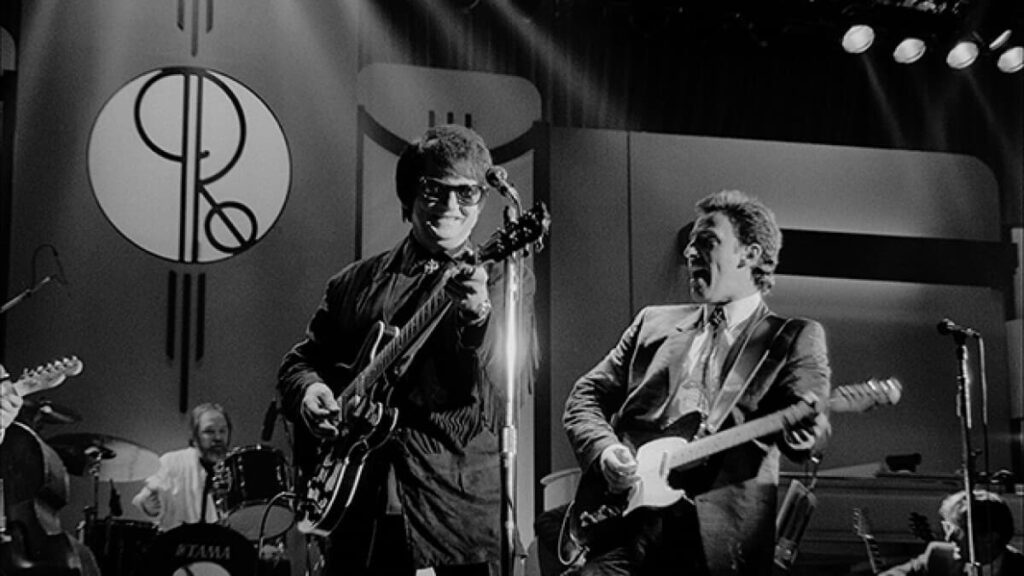
When Roy Orbison stormed into “Go! Go! Go! (Down the Line)” during the televised celebration of Black & White Night 30, it felt less like nostalgia and more like unfinished business finally catching fire again. Originally written by Orbison and released in 1956 during his Sun Records years, the song belonged to the wild, untamed chapter before the world came to know the operatic heartbreak of “Only the Lonely” or “Crying.” Decades later, inside the restored energy of Black & White Night 30, the performance reintroduced audiences to the raw engine underneath the dark glasses and trembling ballads. The special itself revived one of the most beloved live recordings in rock history, reconnecting Roy Orbison with a younger generation while reminding longtime listeners that before he became the poet of loneliness, he was forged in pure rockabilly velocity.
What makes “Go! Go! Go! (Down the Line)” so fascinating is the way it exposes the duality at the center of Orbison’s artistry. The public memory often preserves him as a still figure standing under dim blue light, singing about heartbreak with near-operatic gravity. Yet this song reveals the restless young Texan who absorbed rhythm and blues, country, and early rock ’n’ roll with almost reckless enthusiasm. The track races forward with locomotive momentum, driven by slapback rhythm, pounding percussion, and a vocal performance that sounds eager to outrun itself. There is almost no emotional restraint here. Instead, there is movement, hunger, speed. It is the sound of America in the mid-1950s hurtling toward a new identity.
By the time of Black & White Night 30, that youthful urgency had transformed into something deeper. Orbison no longer sang the song as a young man desperate to break through. He sang it as a survivor revisiting the road that first carried him away from obscurity. That subtle difference gives the performance extraordinary emotional texture. Every shouted phrase feels connected to decades of triumph, grief, disappearance, and resurrection. The energy remains explosive, but beneath it sits the wisdom of a man who understood how quickly glory can fade and return.
The staging of the performance only strengthens that feeling. Surrounded by musicians and admirers who had grown up revering him, Roy Orbison appears almost amused by the ferocity of his own past. Yet the moment the rhythm kicks in, the years collapse. The voice still cuts through with astonishing force. Not polished. Not softened. Alive. There is a remarkable tension between the elegant black-and-white aesthetic of the concert and the unruly rockabilly chaos of the song itself. That contrast becomes part of the magic. It is history confronting its younger reflection.
Lyrically, “Go! Go! Go! (Down the Line)” is not built on intricate poetry. Its power comes from repetition, propulsion, and instinct. The words behave almost like percussion, pushing the listener forward without pause. But beneath the simplicity lies something essential to early rock music: escape. Movement meant freedom. Motion meant possibility. The train imagery and relentless pacing reflect an America obsessed with highways, radio waves, and reinvention. Orbison captured that spirit before his songwriting evolved toward emotional complexity.
Today, the performance endures because it reveals the full architecture of Roy Orbison’s legacy. Not merely the wounded romantic in dark glasses, but the fierce rockabilly craftsman who helped build the foundations of rock ’n’ roll itself. Black & White Night 30 did more than celebrate a legend. It restored the dangerous spark at the beginning of his story and reminded the world that long before heartbreak became his signature, velocity was his first language.