
A tender gaze frozen in time, where innocence and longing meet beneath the glow of first love
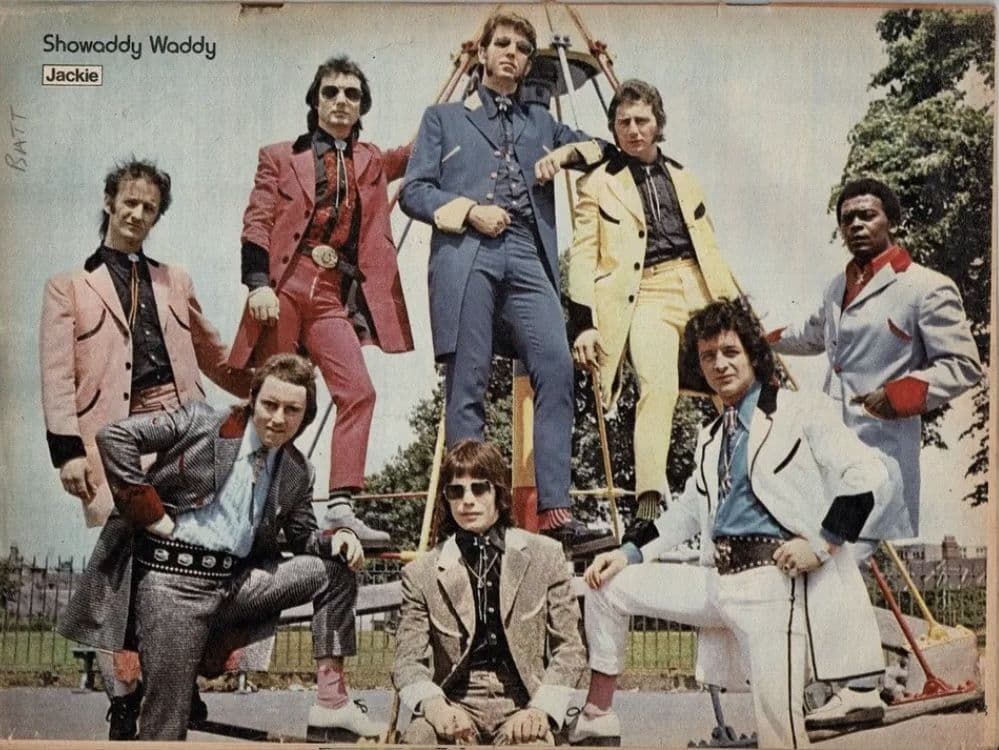
When Showaddywaddy revived Pretty Little Angel Eyes in 1978, they carried a piece of early 1960s romanticism into a late-decade landscape increasingly defined by change. Their rendition climbed into the UK Top 5 on the Singles Chart, reaffirming the band’s role as custodians of rock and roll nostalgia. Though not tied to a singular defining studio album, the track became an essential part of their recorded legacy, sitting comfortably alongside the revivalist spirit that defined much of their catalogue.
Originally recorded by Curtis Lee in 1961, Pretty Little Angel Eyes belongs to that golden moment when pop music was still discovering how to articulate youthful devotion. In the hands of Showaddywaddy, however, the song transforms from a period piece into something more enduring. Their interpretation does not merely imitate the past. It refracts it through the lens of memory, turning the song into an echo of an era already slipping into legend.
At its core, Pretty Little Angel Eyes is built on a deceptively simple emotional premise. The lyrics speak of admiration, of a love so pure it borders on reverence. Yet beneath that simplicity lies a deeper resonance. The repeated imagery of “angel eyes” suggests not just beauty, but distance. The beloved is elevated, almost untouchable, existing somewhere between reality and idealization. This is not a grounded, everyday romance. It is the kind of love that lives in memory, heightened and softened by time.
Musically, Showaddywaddy approach the song with a careful balance of fidelity and personality. Their arrangement retains the buoyant rhythm and melodic charm of early rock and roll, but their vocal delivery introduces a subtle maturity. There is a warmth in the harmonies, a sense that these voices are looking back as much as they are expressing present emotion. The result is a performance that feels both immediate and reflective, as though the band is reliving a moment even as they sing it.
This duality is what gives the song its enduring power. It operates on two emotional planes at once. For younger listeners, it captures the thrill of first love, that almost overwhelming sense of wonder when affection feels infinite. For older audiences, it becomes something else entirely. It is a reminder of how those early emotions linger, how they shape the way love is remembered long after the moment has passed.
Within the broader arc of Showaddywaddy’s career, Pretty Little Angel Eyes stands as a testament to their unique cultural role. At a time when music was moving toward punk’s raw urgency and disco’s polished escapism, they chose instead to preserve and reinterpret the emotional language of an earlier generation. Their success with the song suggests that nostalgia is not merely about looking backward. It is about recognizing that certain feelings, once captured in melody and lyric, never truly fade.
In the end, Pretty Little Angel Eyes endures not because it is complex, but because it is sincere. It reminds us that even in an ever-changing musical landscape, there is always space for a song that simply dares to feel, deeply and without irony.