
Memory of love preserved in melody, where joy and longing become inseparable
When Fats Domino brought Blueberry Hill into the mainstream consciousness in 1956, the song did more than climb the charts. It reached No. 2 on the Billboard pop chart and secured the No. 1 position on the R&B chart, becoming the defining track of his album This Is Fats Domino. Yet statistics alone cannot capture its enduring presence. Its performance on The Ed Sullivan Show elevated it further, placing Domino’s warm, unassuming charisma before a national audience and transforming a beloved tune into a cultural landmark.
Originally written years earlier, Blueberry Hill found its definitive voice in Domino’s interpretation. What distinguishes his version is not reinvention through complexity, but through feeling. The arrangement is deceptively simple: a steady, rolling piano line, a gentle backbeat, and a vocal delivery that feels as though it is being shared rather than performed. Domino did not impose himself upon the song. He settled into it, allowing its nostalgia to unfold naturally.
At its core, Blueberry Hill is a meditation on memory. The lyrics trace the arc of a love once found and later lost, yet the tone is never bitter. Instead, it carries a quiet acceptance, as if the act of remembering is itself a kind of solace. The hill becomes less a physical place and more a symbolic landscape where happiness once existed in its purest form. Domino’s phrasing lingers just behind the beat, creating a sense of time suspended, as though the past is always within reach but never fully recoverable.
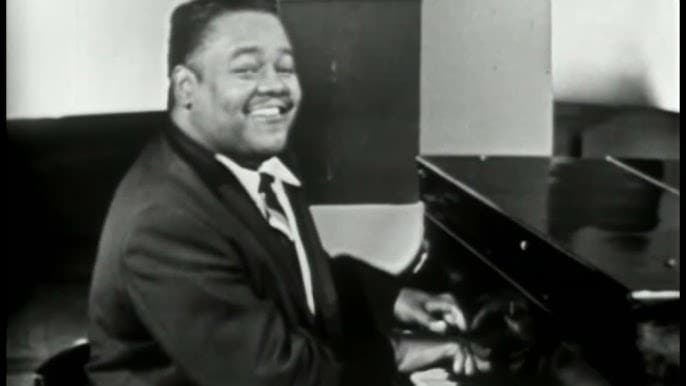
The significance of the Ed Sullivan performance cannot be overstated. In that moment, Fats Domino embodied a bridge between musical worlds. Rock and roll was still carving its identity, and Domino, with his roots deeply embedded in New Orleans rhythm and blues, brought a softness and accessibility that broadened its appeal. Watching him at the piano, smiling gently, one sees none of the rebellious posturing often associated with the era. Instead, there is humility, a quiet confidence that the music speaks loudly enough on its own.
Musically, the song thrives on restraint. The chord progression moves with an almost lullaby-like inevitability, while Domino’s piano anchors the piece with a rolling, triplet-based rhythm that became one of his signatures. This interplay between structure and subtle variation allows the emotional weight to surface gradually. Each repetition of the melody feels slightly more reflective, as though the singer is sinking deeper into memory with every line.
Decades later, Blueberry Hill remains a touchstone not because it demands attention, but because it invites it. It asks the listener to slow down, to recall their own moments of fleeting happiness, and to sit with the bittersweet realization that such moments, once passed, can only be revisited in fragments. In the hands of Fats Domino, that realization is not tragic. It is human, gentle, and enduring.