
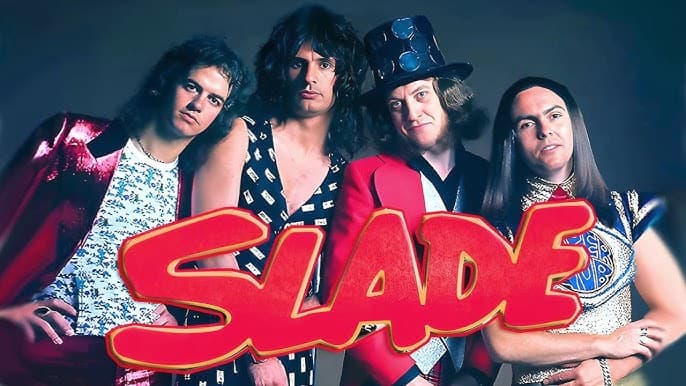
A roaring collision of chaos and camaraderie where rock and roll becomes less a performance than a shared eruption of energy
When Slade took the stage at Winterland on April 8, 1975, they arrived not merely as hitmakers riding the momentum of glam rock, but as one of the most ferociously effective live bands of their era. By this point, the group had already dominated UK charts with an extraordinary run of singles including Cum On Feel the Noize, Mama Weer All Crazee Now, and Far Far Away, while albums such as Old New Borrowed and Blue had solidified their commercial power. Yet recordings alone never fully captured what made Slade exceptional. Their reputation was built in concert halls, in the overwhelming physicality of performance, and the Winterland show stands as one of the clearest documents of that truth.
At its core, the concert reveals a band operating with relentless momentum. Slade never approached live music with refinement as the primary goal. Their power came from immediacy. The feeling that the songs were being hurled directly into the audience rather than carefully presented to them. From the opening moments, the performance carries a sense of barely controlled chaos, but beneath that apparent disorder lies remarkable precision. The band understands exactly how to sustain tension, when to accelerate, and when to let the crowd become part of the music itself.
Central to this force is Noddy Holder, whose voice functions less like a conventional lead vocal and more like a rallying cry. Holder does not merely sing to the audience. He commands them, pulling listeners into the performance with a rawness that feels almost confrontational in the best possible sense. His delivery carries grit, humor, swagger, and exhaustion all at once, embodying the working-class spirit that defined so much of Slade’s identity.
Beside him, guitarist Dave Hill transforms visual flamboyance into kinetic energy. Yet beneath the glitter and theatrics lies a deeply disciplined rhythm section and an instinctive understanding of groove. This balance between spectacle and musicianship is what separates Slade from many glam-era contemporaries. The image may have drawn attention, but the sheer physical force of the music sustained it.
The 1975 timing of the concert is particularly significant. Glam rock’s commercial peak was beginning to shift, and the broader rock landscape was becoming heavier, darker, and more fragmented. Yet at Winterland, Slade sound unconcerned with trends. They play with the confidence of a band fully aware of their strengths. The result is not nostalgic even in retrospect. It feels immediate, urgent, and alive.
Musically, the concert strips the songs back to their essential power. Studio polish gives way to volume, speed, and crowd interaction. Anthems that already carried massive choruses become even more explosive in the live setting, transformed into communal experiences rather than isolated performances. The audience does not simply observe. They participate, shouting refrains back with the kind of intensity that turns rock music into ritual.
What makes the Winterland 1975 performance endure is its honesty. There is no calculated mystique, no attempt at artistic distance. Slade present themselves fully and without apology. Loud, rough-edged, celebratory, and deeply human.
And as the concert races forward with sweat, distortion, and thunderous singalongs, one truth becomes unmistakable. Slade were never simply a glam rock band. They were one of the great live rock and roll machines of their generation, built not on elegance, but on the ecstatic release that only a truly committed band can create.