
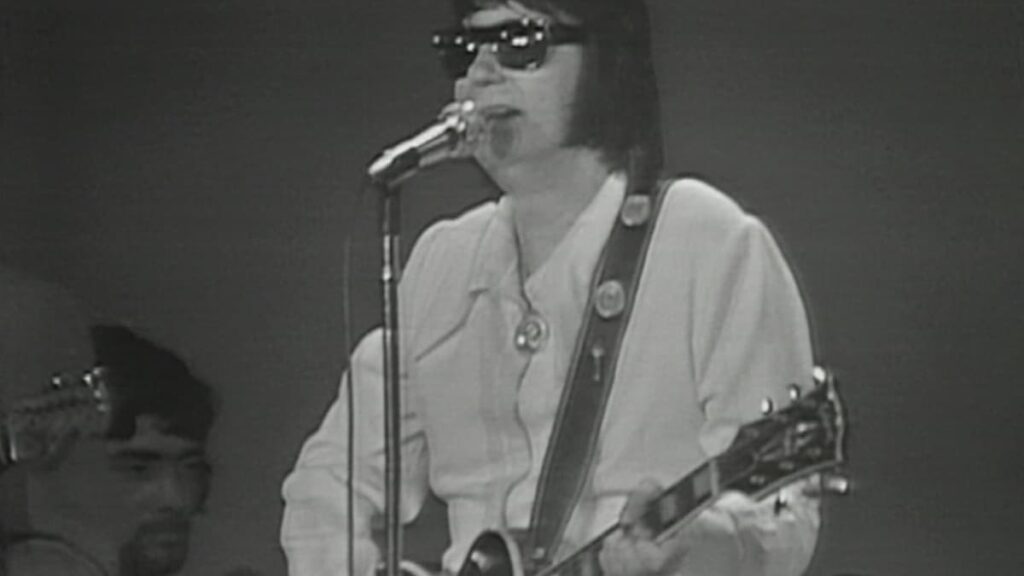
A man sings softly about fear, and somehow turns heartbreak into opera.
When Roy Orbison released “Running Scared” in 1961, the single did something remarkable for a record built almost entirely on emotional restraint: it climbed to No. 1 on the Billboard Hot 100 in the United States and reached the Top 10 in the United Kingdom, later becoming one of the defining centerpieces of his landmark album “Crying.” More than six decades later, the 1972 Australian live performance reveals something even more enduring than commercial success. It shows an artist who no longer needed to prove the power of the song because the audience already carried its tension inside them before he even reached the final note.
What makes “Running Scared” extraordinary is how little it relies on traditional rock-and-roll mechanics. There is no explosive chorus arriving every thirty seconds. No dramatic percussion forcing emotion onto the listener. Instead, the song moves like a tightening wire. Orbison and co-writer Joe Melson built the composition almost like a classical bolero, allowing anxiety to grow inch by inch until the inevitable emotional collapse arrives in the final seconds.
The narrative itself is deceptively simple. A man fears losing the woman he loves to a former lover who suddenly reappears. Yet Orbison never performs the song with masculine bravado. He does not threaten. He does not fight. He waits. That is the genius of the piece. “Running Scared” is not about rivalry. It is about vulnerability. The terror comes from silence, from uncertainty, from the humiliating possibility that love may not choose you after all.
By the time Orbison performed the song live in Australia in 1972, his voice had matured into something even heavier with experience. The studio recording from 1961 already carried loneliness inside it, but the live rendition feels weathered by life itself. Orbison stands almost motionless, dressed in black, hidden behind those famous dark glasses, and somehow becomes larger than the stage around him. He never needed theatrical movement because the drama was entirely contained in the voice.
And then comes that ending.
One sustained high note. No safety net. No falsetto escape. Just pure emotional release.
Few moments in popular music history feel as naked as the climax of “Running Scared.” It arrives not as technical showmanship, but as emotional surrender. The man who spent the entire song quietly fearing abandonment suddenly sounds as though his entire soul has burst open at once. That is why the performance still unsettles listeners decades later. It captures a universal human fear most songs only gesture toward: the fear that love is temporary, fragile, and always one moment away from disappearing.
In the broader landscape of early 1960s music, Roy Orbison occupied a strange and almost mythical place. While many rock singers projected confidence, rebellion, or swagger, Orbison specialized in emotional exposure. His heroes were not conquerors. They were wounded men standing alone beneath neon lights, trying desperately to hold themselves together. “Running Scared” may be one of the purest expressions of that identity ever recorded.
The 1972 Australian performance preserves that truth beautifully. Age had not softened the song. If anything, it deepened its ache. Orbison no longer sounded like a young man afraid of losing love for the first time. He sounded like someone who understood how often life asks people to live with fear and keep singing anyway.