
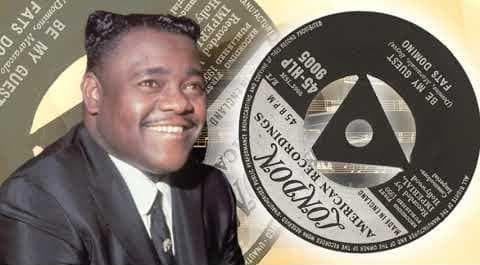
A simple invitation became one of rock and roll’s warmest declarations of belonging
Recorded on September 26, 1959, “Be My Guest” arrived during the extraordinary commercial peak of Fats Domino, climbing to No. 8 on the Billboard pop chart and No. 2 on the R&B chart shortly after its release on Imperial Records. Unlike many later-era rock releases carefully framed around a concept album, the song emerged first as a stand-alone single, part of the remarkable run of recordings Domino produced in New Orleans alongside producer Dave Bartholomew during the late 1950s.
What makes “Be My Guest” endure is not complexity. In truth, the song survives because of its disarming simplicity. Domino never needed grand philosophical statements or tortured poetry to communicate emotional truth. His genius lived elsewhere, in warmth, rhythm, hospitality, and the quiet confidence of a man who understood that joy itself could carry emotional weight.
By 1959, rock and roll was beginning to splinter into competing identities. Some artists leaned harder into rebellion. Others softened into polished teen pop. Yet Domino remained almost untouched by those extremes. His music still carried the pulse of New Orleans rhythm and blues, rooted in neighborhood dances, front-porch laughter, second-line rhythms, and the rolling piano style that made his records feel less like performances and more like invitations into a room already alive with celebration.
That spirit is the heartbeat of “Be My Guest.”
The lyrics are astonishingly direct. There is no hidden metaphor, no elaborate narrative arc. Domino simply opens the door. “Come on baby and be my guest.” In another singer’s hands, the phrase might have sounded flirtatious or disposable. Domino transforms it into something communal. The song radiates generosity. It is music built around inclusion rather than spectacle.
And beneath that cheerful surface lies one of the great understated achievements of late-1950s rhythm and blues: the groove itself.
The recording swings with an offbeat pulse that many historians and musicians later connected to the emerging sound of Jamaican ska. The rhythmic accents, especially the emphasis behind the beat, traveled far beyond American radio. In Jamaica, New Orleans R&B records were devoured by local sound systems, and Domino’s records became foundational listening for young musicians shaping a new genre from imported rhythm and blues traditions.
That historical footprint gives “Be My Guest” an importance larger than its modest running time might suggest. It was not merely another jukebox hit from the golden age of singles. It became part of a musical bridge between New Orleans and Kingston, between American rock and roll and the Caribbean rhythms that would eventually influence the entire world.
Yet even with that cultural significance, the emotional power of the song remains deeply human and intimate. Domino’s voice never strains for attention. He sounds relaxed, almost conversational, as though he is smiling through every line. His piano dances rather than dominates. The band follows him with effortless swing, creating the sensation that the music could continue forever after the record fades.
That was always part of Fats Domino’s quiet brilliance. While so many rock pioneers projected danger, swagger, or heartbreak, Domino projected comfort. He made listeners feel welcomed. In an era obsessed with youth rebellion, he offered something rarer: reassurance.
More than six decades later, “Be My Guest” still sounds like the door opening on a crowded Saturday night somewhere in New Orleans, the piano already echoing from inside, the laughter already rising into the humid air. Some songs ask to be admired. This one simply asks you to come in.