
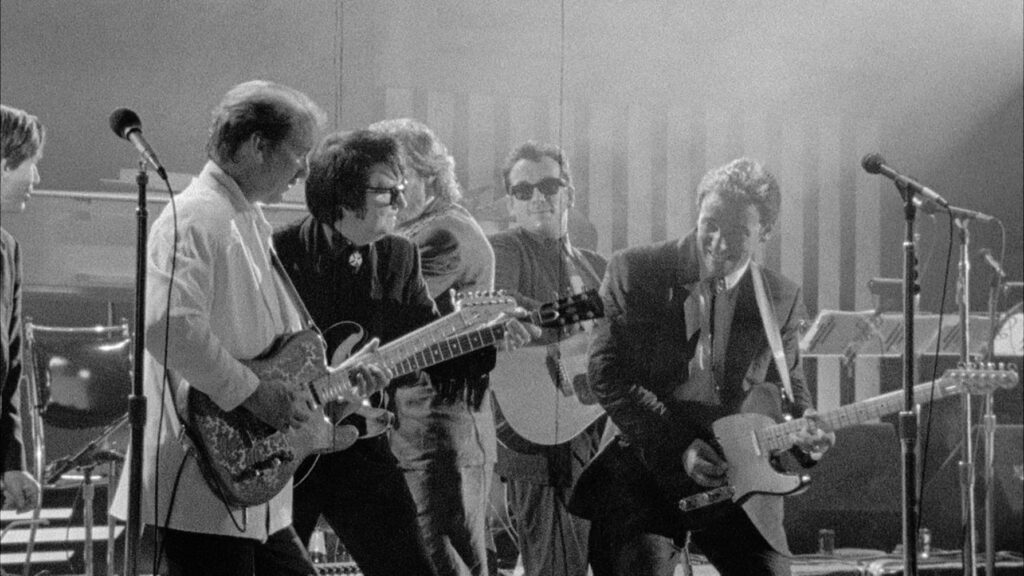
A Rockabilly Spark That Reminded the World Where Roy Orbison’s Fire Began
When Roy Orbison launched into “Ooby Dooby” during the legendary Black and White Night television concert in 1987, the moment felt less like nostalgia and more like a resurrection. Originally released in 1956 on the tiny Je-Wel label before finding national exposure through Sun Records, the song became Orbison’s first charting single, reaching the Billboard Top 60 and introducing America to a young Texas singer whose voice would soon reshape popular music. By the time it reappeared on the celebrated live album Black and White Night, however, “Ooby Dooby” carried an entirely different weight. It was no longer just the reckless anthem of a restless rockabilly kid. It had become a portal back to the beginning of a career that would eventually define loneliness, heartbreak, and operatic vulnerability in American music.
The genius of the performance lies in the contrast. Audiences had come to associate Roy Orbison with the towering emotional architecture of songs like “Crying”, “In Dreams”, and “Only the Lonely.” Yet “Ooby Dooby” belonged to a different universe entirely. It was born in the sweaty corners of West Texas dance halls, where rhythm mattered more than refinement and where young musicians were chasing the electricity that Elvis Presley, Carl Perkins, and Buddy Holly had unleashed across the South. Written by college friends Dick Penner and Wade Moore, the song was intentionally playful, driven by a hiccupping vocal rhythm and a swagger that practically demanded movement. Orbison, still years away from becoming the dark-suited poet of heartbreak, attacked it with youthful abandon.
That is precisely what makes the Black and White Night rendition so emotionally fascinating. By 1987, Orbison was no longer the nervous young singer trying to break into radio. He was a survivor carrying decades of triumph and devastating personal loss. He had endured the deaths of his wife Claudette and two of his sons, watched musical trends shift around him, and spent years underestimated by an industry that often failed to understand the sophistication of his artistry. Standing under those bright stage lights, surrounded by admirers like Bruce Springsteen, Elvis Costello, and Tom Waits, he revisited “Ooby Dooby” not as a relic, but as living proof that the spirit inside him had never disappeared.
Musically, the song remains gloriously uncomplicated. The rhythm bounces with the loose confidence of early rockabilly, while Orbison’s vocal delivery reveals flashes of the dramatic phrasing that would later become his signature. Even in this youthful material, there is a sense that he was already reaching beyond the limitations of conventional rock and roll. His voice does not merely ride the rhythm. It stretches against it, searching for something larger, more emotional, more cinematic.
In the context of Black and White Night, “Ooby Dooby” serves another purpose entirely. It reminds listeners that before the grandeur, before the tragedy, before the myth of Roy Orbison fully crystallized, there was joy. There was speed. There was the reckless confidence of a young musician discovering that music could transform an ordinary room into something alive and dangerous. Watching him perform it decades later feels almost miraculous because the years had not erased that spark. If anything, time had deepened it.
That is why the performance continues to endure. It captures an artist standing face to face with his own beginnings and finding that the heartbeat of the music still remained intact. Not preserved like a museum piece, but alive, loud, and smiling back at him through every ringing guitar chord.