
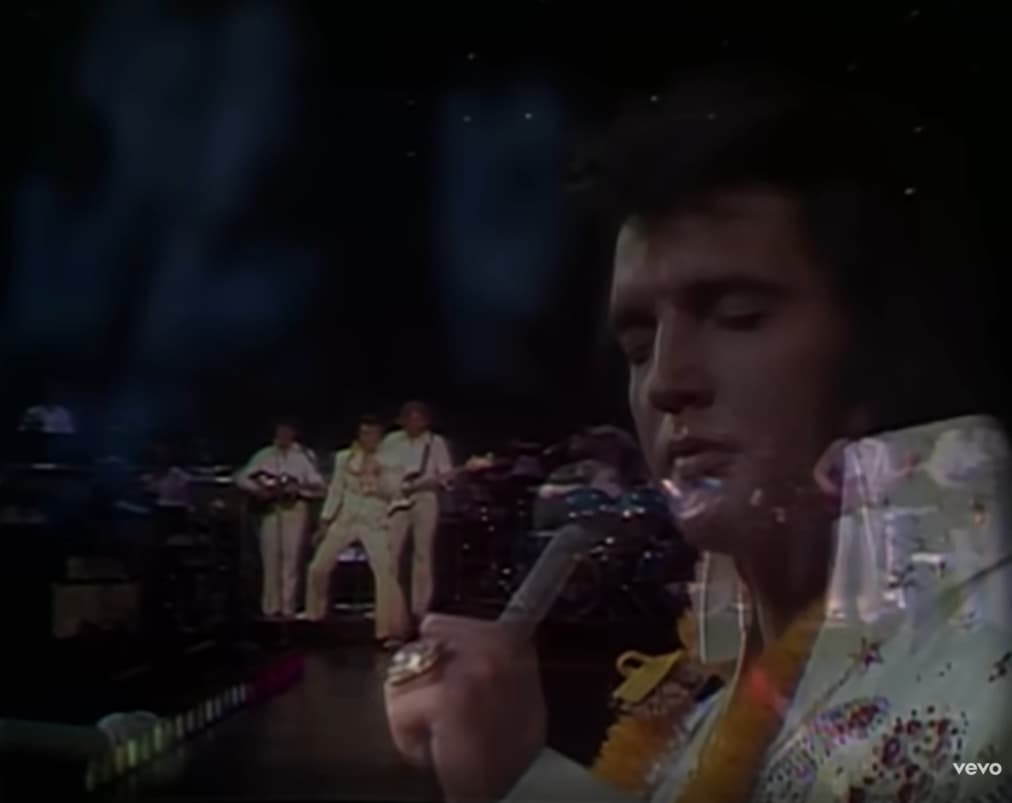
A Man Standing Before the World, Singing Not of Triumph, but of Reckoning
When Elvis Presley stepped onto the stage in Honolulu for the globally televised Aloha from Hawaii via Satellite concert in January 1973, he was not merely performing a standard from the American songbook — he was confronting his own mythology in public view. His rendition of “My Way”, originally immortalized by Frank Sinatra, arrived at a moment when Elvis himself stood at a strange crossroads between cultural immortality and personal exhaustion. Broadcast to millions across dozens of countries, the performance became one of the defining emotional peaks of the landmark Aloha from Hawaii special, an event tied to the album Aloha from Hawaii: Via Satellite. By then, Elvis had already reclaimed chart dominance with recent successes like Burning Love, yet “My Way” offered something charts could never fully measure: the sound of a man taking inventory of his life before the world could do it for him.
What makes Elvis’s interpretation extraordinary is that he does not sing the song with Sinatra’s polished detachment or aristocratic confidence. Sinatra approached “My Way” like a statesman closing the final chapter of a hard-fought career. Elvis, by contrast, sings it like a wounded survivor still trapped inside the storm. There is strain in his phrasing, vulnerability in the pauses, and a haunting weariness beneath the grandeur of the arrangement. Every line feels less like a declaration and more like an argument with fate itself.
By 1973, the mythology surrounding Elvis Presley had become impossibly heavy. He was no longer the rebellious young man from Sun Records scandalizing America with “That’s All Right” and “Heartbreak Hotel.” He was an international institution — adored, scrutinized, consumed. The white jumpsuit, the dramatic cape, the orchestral arrangements, the massive arena spectacle: all of it suggested power. Yet inside “My Way”, another truth emerged. Elvis sounded like a man trying to convince himself that the sacrifices, excesses, and loneliness had meant something.
The arrangement during the Honolulu concert amplifies that emotional contradiction beautifully. The orchestra swells with almost cinematic force, while Elvis’s voice shifts between commanding authority and startling fragility. He does not glide through the lyrics; he wrestles with them. When he reaches the song’s climactic reflections on regret and resilience, the performance stops feeling like entertainment entirely. It becomes confession.
That is why this version has endured far beyond the concert itself. It was not technically perfect, nor was it intended to be. What audiences remember is the humanity embedded within it. Elvis understood, perhaps more deeply than most performers ever could, the terrible cost of becoming larger than life. “My Way” gave him a rare opportunity to speak through a song already weighted with themes of pride, failure, independence, and mortality.
Viewed now, decades later, the performance carries an almost unbearable poignancy. History would cast the remaining years of Elvis’s life in increasingly tragic light, and because of that, the words “I faced it all and I stood tall” resonate with a gravity they may not have carried in the moment. The audience in Honolulu saw a superstar. Posterity sees something more complicated: a man fiercely holding onto dignity while the world watched him fade in slow motion.
And perhaps that is the enduring power of Elvis Presley’s “My Way.” It is not the sound of victory. It is the sound of a human being trying to leave behind a coherent story about himself before the curtain finally falls.