
A Heart That Sang for Millions Finally Fell Silent Somewhere Between the Highway and Home
By the time Conway Twitty faced the final miles of his touring life in June 1993, he had already become something larger than country music itself — a voice woven into the emotional memory of America. The architect of more than 50 No. 1 country hits, the man behind timeless recordings like “Hello Darlin’,” “Linda on My Mind,” and “Slow Hand,” had spent decades turning heartbreak into an art form. His final performances came during the era following “Final Touches,” one of the last studio albums released during his lifetime, a record that reflected the weary tenderness of an artist who never stopped singing about longing, devotion, and regret. Though no single “last song” defines that tragic final day on the road, the story of Conway Twitty’s final hours has become one of country music’s most haunting closing chapters.
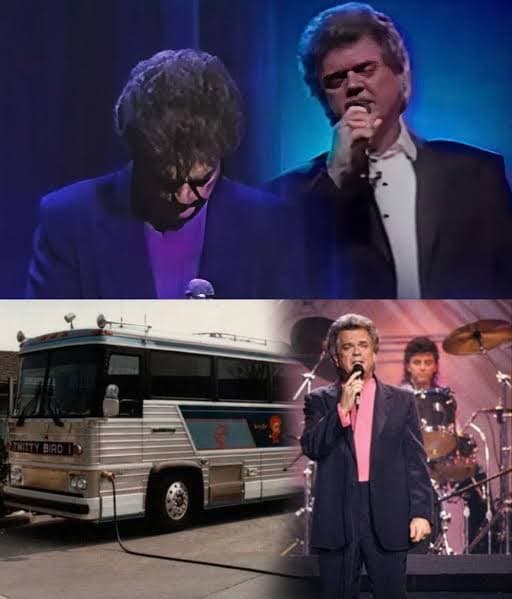
On June 4, 1993, after performing at the Jim Stafford Theatre in Branson, Missouri, Conway Twitty began experiencing severe pain backstage. Witnesses later recalled that he initially dismissed it with the same quiet professionalism that had defined his career. For decades, the road had demanded endurance from him — endless buses, late-night shows, smiling through exhaustion, carrying the emotional burdens of songs that listeners treated almost like private confessions. But this time was different. The pain intensified during the trip home aboard his tour bus. Soon after, he was rushed to a hospital in Springfield. He died the next day from an abdominal aortic aneurysm. He was 59 years old.
There is something deeply symbolic about the way Conway Twitty’s story ended: not in retirement, not in silence, but while still traveling between audiences who adored him. He died exactly where he had spent most of his adult life — somewhere on the road, suspended between performance and home, between applause and solitude. For artists of his generation, touring was never simply promotion; it was identity itself. The stage was not a place he visited. It was where he lived.
That is why the mythology surrounding his “last day” carries such emotional weight among country music devotees. Conway Twitty represented a style of masculinity rarely preserved in modern music — vulnerable yet restrained, passionate without spectacle. His recordings never relied on grand vocal gymnastics. Instead, he mastered intimacy. He sounded like a man leaning across a dim kitchen table at midnight, finally admitting the truth he had hidden for years.
In retrospect, many of his later recordings feel almost unbearably reflective. Songs about aging love, fading certainty, and emotional exhaustion gained a new gravity after his death. The polished countrypolitan arrangements, the velvet baritone, the pauses between phrases — they all seemed to carry the fatigue of a man who had given everything to the audience long before his body finally surrendered.
Yet the tragedy of Conway Twitty’s last day is inseparable from the triumph of his legacy. Few artists remained culturally relevant across as many eras. He began in rock and roll during the 1950s, crossed fully into country in the late 1960s, and ultimately became one of the genre’s defining storytellers. Generations of singers borrowed from his phrasing, his emotional precision, and his ability to transform ordinary romantic pain into something almost cinematic.
Even now, decades later, the story still resonates because it feels strangely fitting: the great chronicler of loneliness leaving this world in transit, still carrying the echoes of one more crowd, one more song, one more night beneath the stage lights.