
A Song About Innocence Lost Beneath the Spotlight of Desire
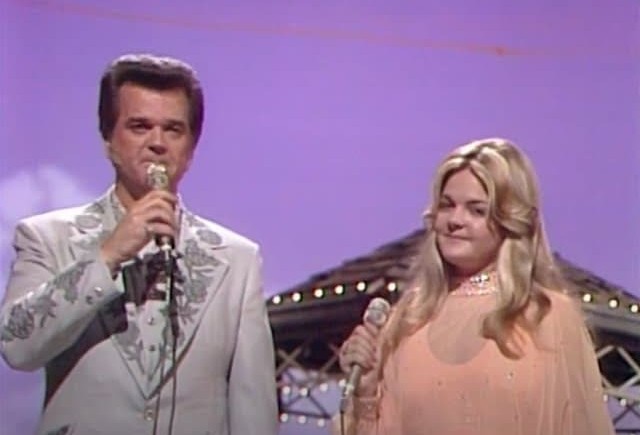
When Conway Twitty released “Don’t Cry Joni” in 1975 on the album The High Priest of Country Music, the song climbed to No. 4 on the Billboard Hot Country Singles chart, becoming one of the most emotionally unsettling and quietly controversial recordings of his career. Performed with his daughter Joni Twitty during live appearances that would later become deeply associated with the song’s legacy, it occupied a strange and unforgettable corner of 1970s country music — part family duet, part dramatic monologue, and part moral cautionary tale. Unlike the warm romanticism that often defined Twitty’s catalog, “Don’t Cry Joni” carried an ache that listeners could not easily shake.
The genius of the song lies in its uncomfortable honesty. Written by Joe Shane, Marty Parker, and Curly Putman, the narrative unfolds with deceptive simplicity: a young girl becomes infatuated with an older man, only to be gently rejected because of her age. Years later, time alters the emotional geometry. The girl has become a woman, and the man who once turned away now finds himself overwhelmed by regret and longing. In lesser hands, the premise could have collapsed into melodrama. But Conway Twitty approached it with the restraint of a seasoned storyteller rather than a theatrical performer. His voice never pushes too hard. He lets the pauses speak.
That restraint is precisely what makes the song linger in the memory long after the final verse fades. Twitty understood that country music, at its finest, does not merely narrate events — it exposes emotional consequences. The heartbreak in “Don’t Cry Joni” is not simply romantic disappointment; it is the realization that timing itself can become a cruel antagonist. By the song’s conclusion, nobody truly wins. Youth has vanished, innocence has transformed into distance, and the man who once believed he was doing the honorable thing is left staring at the emotional wreckage of missed years.
Musically, the arrangement reflects the understated sophistication of mid-1970s Nashville production. Soft piano lines, restrained strings, and subtle steel guitar create an atmosphere that feels almost cinematic without overwhelming the vocal narrative. The production leaves enormous space around Twitty’s voice, allowing every crack of hesitation and every note of regret to surface naturally. That spaciousness became one of the defining characteristics of his best recordings. He never needed excess ornamentation because his phrasing carried the emotional weight.
Live performances of “Don’t Cry Joni” added another layer entirely. Seeing Conway Twitty sing the song alongside Joni herself created a haunting duality between fiction and reality. Audiences were witnessing a father-daughter performance wrapped around a story of emotional tension and lost innocence. That contrast gave the song an almost theatrical intimacy, one that made viewers simultaneously captivated and reflective. Few country performances of the era carried such psychological complexity beneath such a polished exterior.
Today, “Don’t Cry Joni” endures because it refuses to offer easy comfort. It belongs to a tradition of country storytelling where emotions remain unresolved and human frailty is left exposed rather than redeemed. In an era increasingly dominated by polished sentiment, the song still feels startlingly human — vulnerable, conflicted, and painfully aware that some moments in life arrive either too early or far too late.