
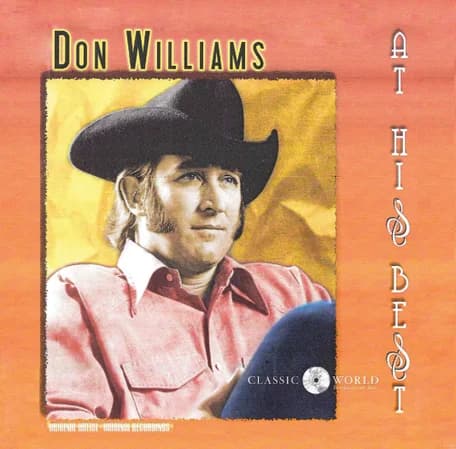
Sometimes the quietest country songs carry the heaviest confessions of the heart.
Released in 1982 on Don Williams’ understated yet deeply resonant album Listen To The Radio, “Don’t Stop Lovin’ Me Now” arrived during one of the most stable and successful stretches of the singer’s career. By that point, Williams had already become one of country music’s most dependable chart presences, a voice audiences trusted not for spectacle, but for emotional truth. While the album itself produced notable country hits and reinforced his dominance on early-1980s radio, “Don’t Stop Lovin’ Me Now” lives in a quieter corner of the record — less celebrated commercially, perhaps, but emotionally revealing in ways that many larger hits never achieve.
What makes the song linger is its emotional timing. Most love songs speak from certainty: certainty of devotion, heartbreak, betrayal, longing. But “Don’t Stop Lovin’ Me Now” is about a man arriving painfully late to his own emotional awakening. The narrator is not asking for love to begin — he is begging for it not to end just as he finally learns how to return it properly. That subtle distinction is where the song earns its quiet power.
The lyrics unfold with almost conversational humility. There is no grand poetic flourish, no dramatic orchestration trying to force emotion into the listener’s chest. Instead, the song leans into the emotional architecture that defined so much of Don Williams’ work: restraint, sincerity, and a voice that sounded as though it understood disappointment firsthand. When he sings, “I’ve finally figured out that I depend on you,” the line does not feel theatrical. It feels lived in. Weathered. Like a confession made too late at a kitchen table after midnight.
This was the genius of Don Williams. In an era when country music often swung between honky-tonk swagger and polished crossover ambition, Williams specialized in emotional realism. His delivery never begged for applause. He sang like a man speaking softly across a room, trusting the listener to lean closer. That intimacy transformed songs like “Don’t Stop Lovin’ Me Now” into deeply personal experiences. The arrangement follows the same philosophy: gentle rhythm section, warm acoustic textures, and enough space around the melody to let silence become part of the storytelling.
The song also reflects a recurring theme throughout Williams’ catalog — emotional maturity arriving through regret. Unlike youthful love songs driven by passion or fantasy, this is the sound of someone confronting the consequences of emotional distance. The narrator admits he spent too long “trying to live too fast,” and the tragedy embedded in the lyric is that realization alone may not be enough to save the relationship. Country music has always understood that timing can be crueler than heartbreak itself.
There is also something profoundly adult about the song’s vulnerability. The man at the center of “Don’t Stop Lovin’ Me Now” is not proud. He is not heroic. He is simply honest. And honesty, especially in classic country music, often cuts deeper than drama. That honesty helped define why Don Williams became known as “The Gentle Giant” of country music. His records rarely shouted, yet they endured because listeners recognized themselves inside them.
More than four decades later, “Don’t Stop Lovin’ Me Now” still resonates because its emotional premise remains timeless: the fear of understanding love only when it is already slipping away. In the hands of a lesser singer, the song might have sounded sentimental. In the hands of Don Williams, it becomes something far more difficult to achieve — human.