
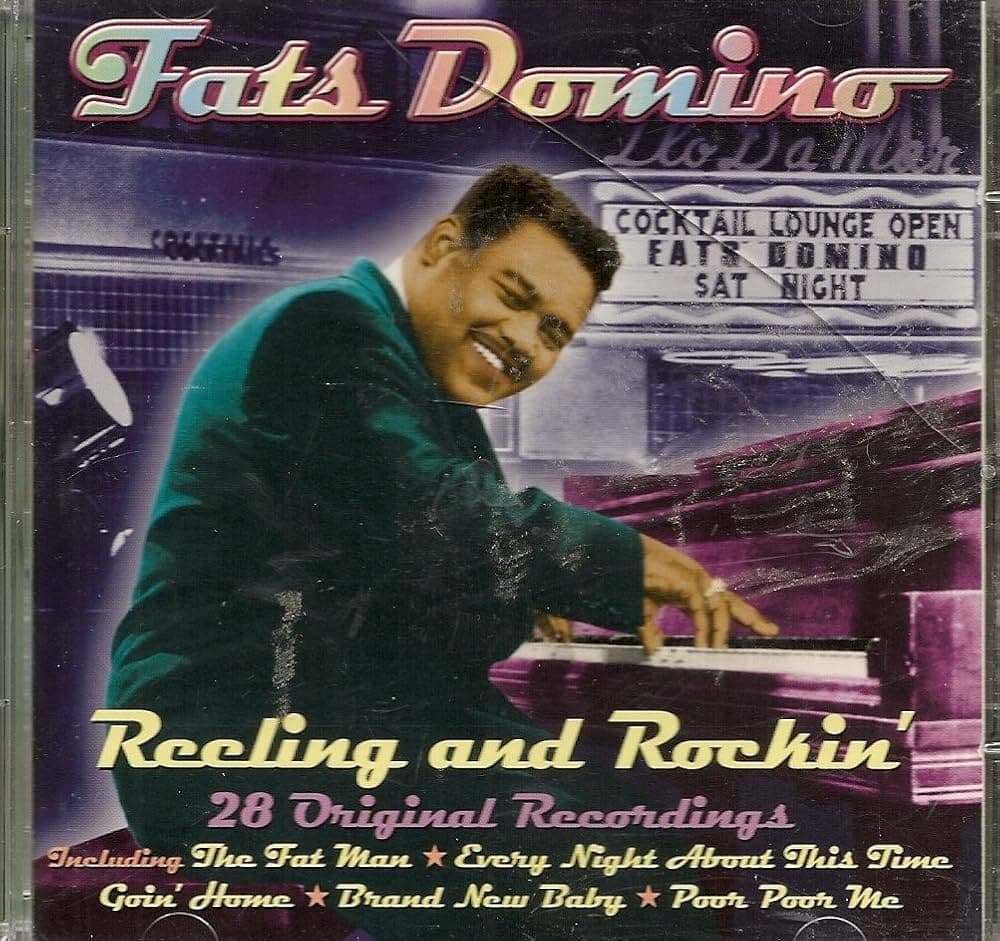
A Quiet Tumult of Heartache, Dressed in Boogie Piano
“Reeling and Rocking” is a bittersweet lament by Fats Domino, first issued in March 1952 as the B-side to the single “Goin’ Home” on Imperial Records. Although not a chart-topping hit in its own right, the song remains a vivid illustration of Domino’s early ability to blend raw emotional honesty with his trademark New Orleans-inflected rhythm and blues.
Recorded during the same session as “Goin’ Home,” “Reeling and Rocking” emerged as a companion piece rather than the flagship single. The A-side “Goin’ Home” became a major R&B success, and though “Reeling and Rocking” did not claim equivalent commercial glory, it nonetheless captures a vulnerable, intimate side of Fats Domino—a side rooted in heartbreak and longing.
At its core, “Reeling and Rocking” is a portrait of emotional disarray. Domino adopts the voice of a man broken by departure—his lover has gone, leaving him with a rockin’ chair in his backyard, and a head full of pain. The repetition of the phrase “reelin’ and a-rockin’” becomes more than just a figure of speech; it’s a physical manifestation of dizziness, imbalance, and deep sorrow. The imagery is simple, but in his hands, it becomes powerful: each rocking motion echoes an internal tremor, each triplet of piano notes mirrors a heartbeat out of sync.
Musically, the song is striking for its modest arrangement. According to analysis from Spontaneous Lunacy, the session lacked the usual presence of producer/arranger Dave Bartholomew, which leaves the track feeling less polished than some of Domino’s largest hits, but strangely more intimate. Domino’s piano triplets dominate the sound, with other instruments maintaining a restrained, almost peripheral role. This structural choice places his voice and his pain firmly at the center. Rather than relying on a complex, interlocking rhythm section, “Reeling and Rocking” leans into its minimalism to convey a weary, world-weary longing.
Lyrically, Domino’s writing (credited to him and Alvin “Al” Young) is deceptively straightforward. The verses don’t offer dramatic metaphors or elaborate narrative twists; they simply state a man’s suffering and his desire to escape it. As he sings, “I feel so bad / I wish that I was dead,” the vulnerability is unvarnished and deeply human. There is no bravado here, no attempt to mask pain with swagger. Instead, the rockin’ chair becomes both a refuge and a reminder—a tangible symbol of loneliness in the backyard of memory.
Though “Reeling and Rocking” did not become one of Domino’s biggest hits, its legacy endures in the deeper folds of his catalog. It appears later on compilation albums, such as The Complete Imperial Singles, and serves as a window into an early phase of his career, when his songwriting was still raw, his arrangements sparse, and his emotional expression unguarded.
In the arc of Fats Domino’s life and work, “Reeling and Rocking” stands as a testament to his ability to convey heartbreak not through bombast, but through honest simplicity. It is not just a song about being left behind—it’s a confession, a slow turning of the chair in an empty yard, and a soul still reverberating with the aftershocks of love lost. For the listener attuned to his deeper currents, this track is a quiet yet profound reminder that even the most unassuming grooves can carry the weight of real human longing.