
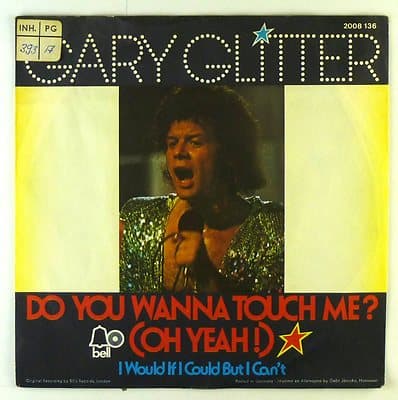
A Primal, Pulsing Call to Contact and Communion in the Heart of Glam Rock
When “Do You Wanna Touch Me? (Oh Yeah!)” stormed the British charts in January 1973, it did so with an immediate and unignorable presence, climbing to No. 2 on the UK Singles Chart and anchoring itself as one of Gary Glitter’s signature songs from his Touch Me album.
From its first thunderous beats, “Do You Wanna Touch Me? (Oh Yeah!)” encapsulates glam rock’s brash physicality and swaggering confidence. Crafted by Glitter and his frequent collaborator Mike Leander, the track departs from mere pop songcraft to become a visceral invocation of shared energy and unbridled impact. Its stomping rhythm and chanted refrain were designed to dissolve the divide between stage and audience—an anthem not merely to be heard, but to be participated in.
Recorded in 1972 and released as the lead single from Touch Me, the song carried forward the momentum Glitter had built with previous hits, embedding itself deep within the sonic landscape of early-1970s Britain. Its success followed a string of chart entries that defined what came to be recognized as “the Glitter Beat,” turning Glitter into a figure whose presence on the pop charts was as commanding as his glitter-laden live performances.
Musically, the track is a study in rhythmic insistence. The relentless backbeat, heavy on handclaps and driving percussion, invokes a sense of collective urgency—the kind that translates effortlessly from dance floors to packed arenas. Glitter’s vocal delivery is unabashed and forthright, pushing the song’s central question with a teasing insistence that feels both playful and provocative. The chorus’s repetition of “Oh yeah!” functions less as lyrical elaboration and more as an exultant release, a communal cry that sweeps up listeners in its momentum.
Lyrically, the song treads a thin line between flirtatious invitation and raw desire. Its directness, stripped of metaphoric veneer, mirrors glam rock’s broader aesthetic of unmasked sensation and bold theatricality. Within the cultural context of the early 1970s—when boundaries in fashion, sexuality, and performance were being actively contested—“Do You Wanna Touch Me? (Oh Yeah!)” fit snugly into a burgeoning era that sought to dismantle restraint and celebrate immediacy.
Yet the legacy of “Do You Wanna Touch Me? (Oh Yeah!)” is complex. While the song remains a defining artifact of its era’s exuberance, its origin in the catalog of an artist whose personal history has since been marred by deeply reprehensible criminal convictions complicates its place within musical memory. Performances, airplay, and associations with Glitter’s name have been reconsidered and often rejected in many forums, even as the song’s indelible groove and influence—especially through high-profile covers like that of Joan Jett—endure in various corners of rock culture.
In its distilled form, “Do You Wanna Touch Me? (Oh Yeah!)” stands as both a product of unabashed glam bravado and a reminder of the tensions that arise when artistic output is inseparable from the moral reckoning of its creator. Its rhythms still pulse with the energy of an era that prized spectacle and surrender, and its place in the annals of rock history remains undeniably vivid.