
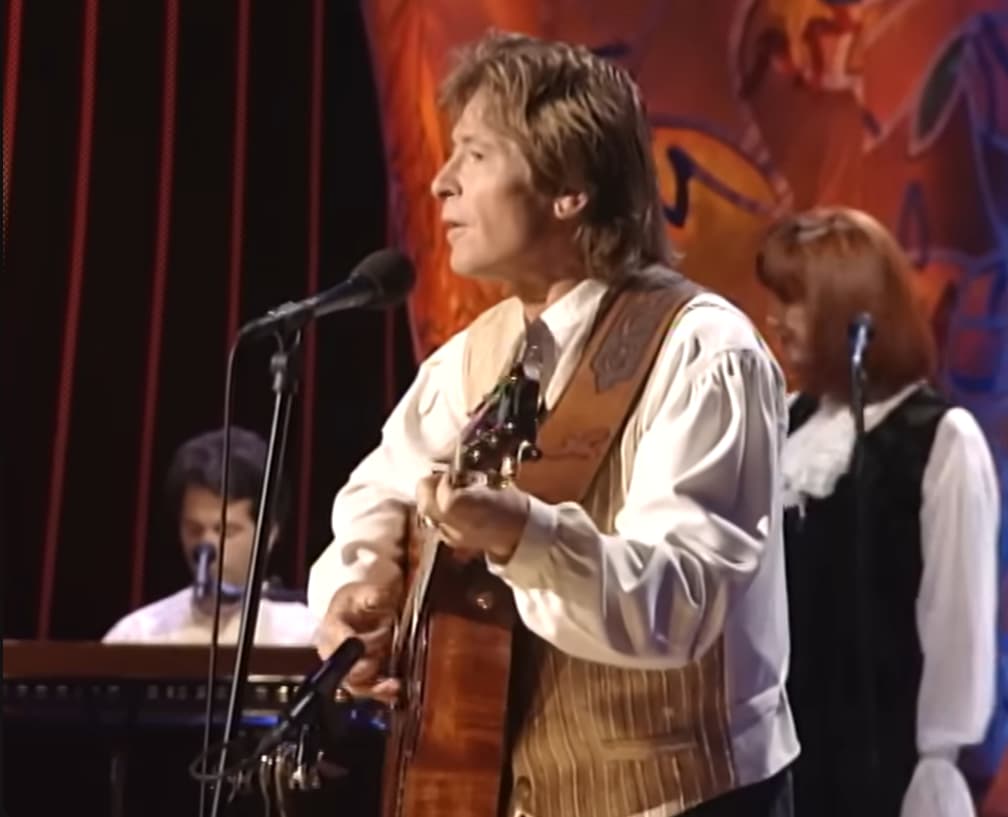
A song about home that became a home for millions of listeners.
When John Denver released “Take Me Home, Country Roads” in 1971, few could have predicted that it would become one of the defining anthems of American popular music. Featured on the album Poems, Prayers & Promises, the song climbed to No. 2 on the Billboard Hot 100 and finished the year among the biggest hits in the United States, establishing John Denver as a major voice of the singer-songwriter era. Yet statistics alone tell only a fraction of the story. More than five decades later, the song endures because it speaks to something deeper than commercial success: the universal longing for belonging.
The version performed during The Wildlife Concert carries an added layer of meaning. Recorded during the later years of Denver’s career, it is not merely a revisit to a beloved hit but a reflection by an artist looking back across the landscape of his own life. The youthful optimism of the original remains intact, yet there is a greater sense of gratitude and perspective in the performance. Every line feels less like a destination being sought and more like a truth that has already been discovered.
The origins of “Take Me Home, Country Roads” are rooted in collaboration, written by John Denver, Bill Danoff, and Taffy Nivert. What makes the song remarkable is its ability to transform geography into emotion. Although the lyrics reference West Virginia, the song’s power does not depend on any specific place. The “country roads” become symbols of memory itself—those invisible paths leading back to childhood, family, innocence, and the people who shaped us.
Listen closely to the lyrics, and the song reveals an elegant simplicity. There is no dramatic conflict, no heartbreak, no elaborate storytelling. Instead, it draws strength from imagery: mountains, rivers, familiar landscapes, and the comforting pull of home. Denver understood that the most profound emotions are often expressed through the simplest words. His warm tenor voice does not command attention; it invites listeners into a shared memory. The result is a song that feels personal even when heard among thousands of strangers.
Musically, the composition balances folk sincerity with country warmth. The acoustic guitar provides a steady foundation, while the soaring chorus creates a sense of open space and movement. Each return to the title phrase feels like another mile traveled toward a cherished destination. It is a melody built for communal singing, which explains why audiences across generations continue to embrace it as their own.
In the context of The Wildlife Concert, the song acquires an almost timeless quality. Denver’s lifelong connection to nature, conservation, and the American landscape echoes through every note. The performance reminds us that home is not merely a house or a town; it is a relationship with the places that shape our identity. That idea helps explain why “Take Me Home, Country Roads” has outlived changing musical trends. It is not simply a song about West Virginia, nor even about America. It is a song about the human desire to return—to memory, to comfort, to the people and places that remain with us long after we have left them behind.
That is why, decades after its release, the road still feels familiar. And every time John Denver sings those opening words, listeners find themselves traveling home once again.