
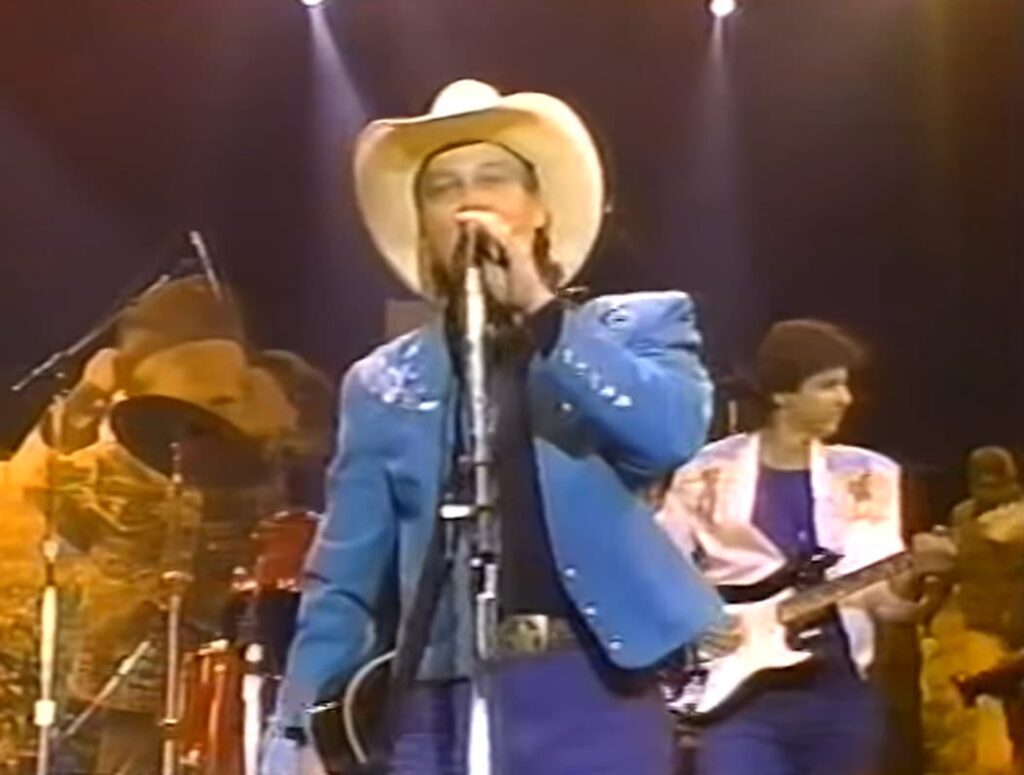
A Song About Desire That Never Hides Behind Coolness or Pride
When Ricky Van Shelton recorded “Oh Pretty Woman” in 1990 for his album RVS III, he was not attempting to reinvent a monument of American songwriting so much as stand respectfully beside it. Originally immortalized by Roy Orbison, whose 1964 recording spent three weeks at No. 1 on the Billboard Hot 100 and became one of the defining singles of the rock-and-roll era, the song already carried the weight of cultural memory long before Shelton approached it. Yet Shelton’s version found its own place within country music’s late-1980s and early-1990s traditionalist revival, bringing Orbison’s lonely street-corner yearning into a warmer, more grounded Southern frame.
There is something fascinating about how “Oh Pretty Woman” survives every generation that touches it. On paper, the lyric is almost startlingly simple. A man sees a woman walking down the street and speaks directly to her beauty, his hope, his panic, and finally his relief when she turns back toward him. But simplicity has always been deceptive in Orbison’s songwriting universe. Beneath the direct language sits an aching emotional exposure that most popular music spends enormous effort trying to avoid. The narrator is vulnerable from the first line. He is not mysterious, guarded, or detached. He wants connection immediately, and he risks embarrassment openly.
That emotional nakedness is precisely why the song endured long enough for an artist like Shelton to inhabit it decades later.
By the time Shelton recorded the track, country music was entering a period where polished production increasingly competed with older traditions of sincerity and plainspoken storytelling. Shelton belonged to the camp that still valued emotional clarity above fashionable irony. His voice — steady, rich, and unhurried — lacked Orbison’s operatic loneliness, but it compensated with intimacy. Shelton sang the song less like a man stunned by fantasy and more like someone standing under the soft glow of a roadside dance hall sign, watching possibility pass him by in real time.
The famous opening guitar figure remains one of the great hooks in American popular music, instantly recognizable even to listeners who may not know the title. But beyond its rhythm and swagger, the song’s true genius lies in tension. Every verse moves between confidence and rejection. The narrator calls out boldly, yet underneath each line is the fear that he will be ignored. That duality — masculine bravado masking fragile hope — gives the song emotional credibility. It understands that longing often arrives dressed as charm.
The story behind the composition has become part of songwriting folklore. Orbison reportedly began writing the song with collaborator Bill Dees after a casual remark about a beautiful woman needing no money. Within less than an hour, the framework of the song had emerged. Like many timeless songs, its construction sounds almost accidental in retrospect, as though it had always existed somewhere in the American bloodstream waiting to be captured.
Shelton’s interpretation reminds listeners that great songs are not preserved by imitation alone. They survive because different voices discover new emotional temperatures within them. Where Orbison’s version feels cinematic and lonely — a man calling into the neon-lit chaos of the city — Shelton’s reading feels rooted in human familiarity. His performance softens the desperation slightly, replacing some of the original tension with warmth and admiration.
And perhaps that is why “Oh Pretty Woman” continues to matter. It is not merely a song about beauty. It is a song about courage — the small, terrifying courage required to speak desire aloud before the world has decided whether to answer it kindly.