
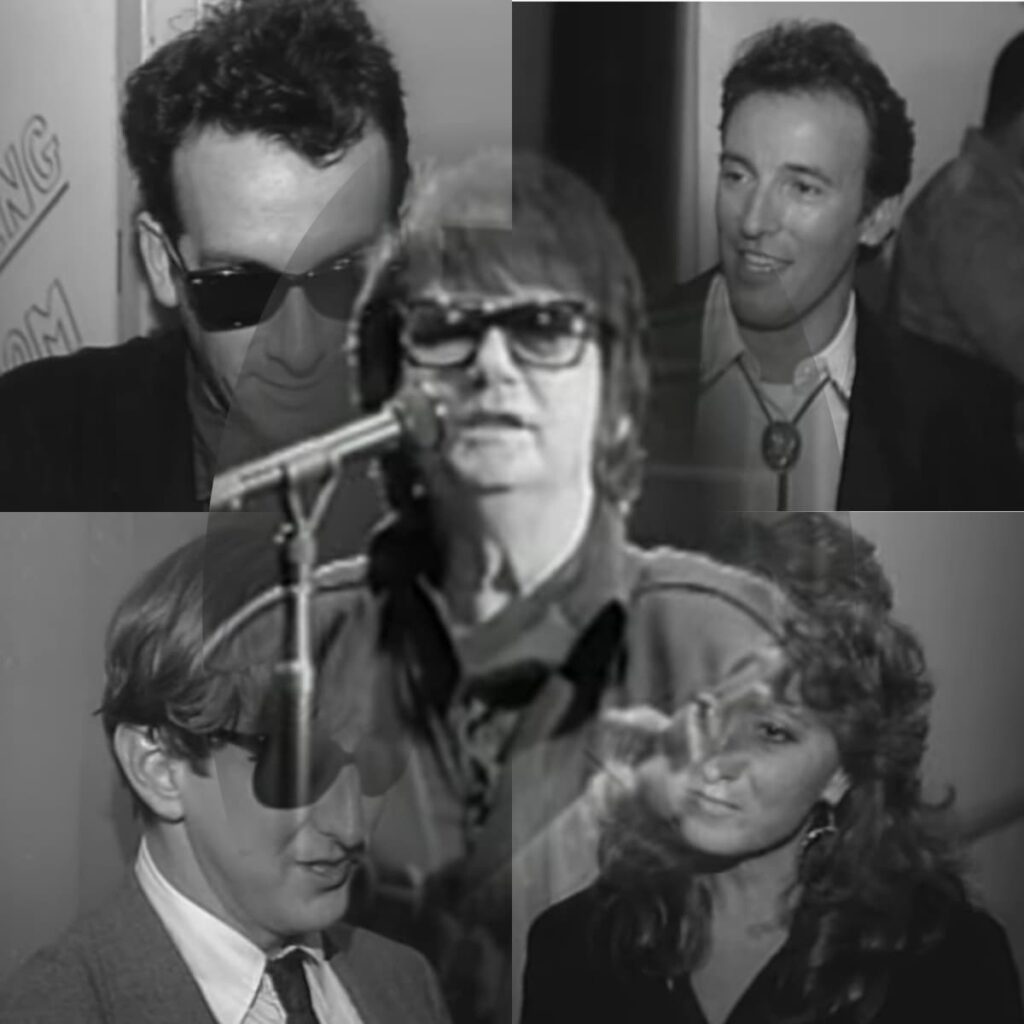
A Night Once Lost to Memory Returned Like a Ghost in Perfect Harmony
When Roy Orbison stepped back beneath the lights for “Black & White Night 30,” the event was never designed as a mere anniversary celebration. It became something far more haunting: a resurrection of atmosphere, dignity, and emotional truth. Released alongside the documentary companion “Behind The Scenes of Black & White Night 30,” the project revisited the legendary 1987 concert originally issued on the album and film Black & White Night, a performance long regarded as one of the most revered live recordings in American popular music. The restored edition found renewed acclaim among critics and longtime listeners alike, particularly for its pristine remastering and intimate archival footage that revealed the fragile humanity behind Orbison’s quiet grandeur.
What makes this material so affecting is not simply nostalgia. Nostalgia alone fades quickly. What survives in Roy Orbison’s world is vulnerability — presented without disguise. By the time of the original Black & White Night performance, Orbison had already endured professional decline, personal tragedy, and years of cultural underestimation. Yet when he walked onto that stage in black clothing and dark glasses, surrounded by an astonishing ensemble of admirers including legends from rock, country, and folk, there was no bitterness in his demeanor. Only restraint. Only focus. The behind-the-scenes footage enriches that mythology by stripping away the mystique just enough for the audience to witness the man beneath it.
The documentary reveals an artist who carried silence almost like another instrument. Orbison never chased the swagger of rock-and-roll contemporaries. He stood nearly motionless while songs erupted around him like emotional storms. Watching the preparation and candid moments surrounding the concert, one understands that this stillness was not detachment — it was control. He sang heartbreak with the discipline of someone who knew pain too intimately to exaggerate it.
That is why the legacy of “Black & White Night 30” feels larger than a restored concert film. It functions as a meditation on artistic survival. The musicians surrounding Orbison were not simply backing players; they were disciples paying tribute in real time. The reverence visible in their expressions tells its own story. Few performers ever commanded such respect without demanding it outright. Orbison achieved it through emotional precision. Every tremble in his voice sounded earned.
The behind-the-scenes perspective also sharpens the emotional contrast that defined Orbison’s career. Here was a singer whose songs dealt relentlessly in loneliness, yearning, and shattered romance, yet whose voice could ascend with almost operatic beauty. In rehearsal fragments and candid exchanges, one sees how naturally melancholy lived within him. There is no theatrical performance of sadness. It simply lingers in the room around him.
And perhaps that is why the restored celebration resonates so deeply with mature listeners today. Modern music often rewards immediacy, confession, and spectacle. Roy Orbison belonged to another tradition entirely — one where emotion was delivered with elegance rather than exposure. The pain in his music was never shouted. It arrived slowly, like headlights appearing on an empty highway at midnight.
“Behind The Scenes of Black & White Night 30” ultimately preserves more than a concert. It preserves the final glow of a generation that understood restraint as a form of poetry. Watching Orbison in those moments feels less like observing a performer and more like opening an old letter whose words have somehow become even sadder — and more beautiful — with time.