
A Love Song Sung in the Shadow of Farewell
When Roy Orbison released “You Got It” in early 1989, the song carried a weight that listeners would only fully understand after his death. Featured on the posthumous album Mystery Girl, the single became Orbison’s first major international comeback hit in decades, reaching No. 9 on the Billboard Hot 100 and climbing even higher overseas, including No. 3 in the UK. Yet chart statistics alone cannot explain why the record still feels suspended outside of time. Performed live during the celebrated 1988 television special A Black and White Night, “You Got It” revealed something deeper: an artist rediscovering the full force of his voice just as fate was preparing to silence it forever.
By 1988, Roy Orbison was no longer merely a relic of early rock and roll nostalgia. He had become something almost mythic. The success of the Traveling Wilburys had introduced him to a younger generation, while longtime admirers never stopped treating his voice as one of the most emotionally devastating instruments popular music had ever known. Unlike many of his contemporaries, Orbison never relied on swagger or rebellion. He sang like a man standing alone beneath midnight streetlights, exposing heartbreak with almost operatic vulnerability.
That is precisely why “You Got It” resonates so powerfully. Written by Orbison alongside Jeff Lynne and Tom Petty, the song could have easily become a polished late-1980s pop production with little soul beneath its sheen. Instead, it feels astonishingly human. Its structure is deceptively simple — a pledge of unconditional devotion — but Orbison transforms those promises into something spiritually larger. When he sings, “Anything you want, you got it,” the line does not sound transactional or casual. It sounds like surrender. Like gratitude. Like a man who understands how fragile love truly is.
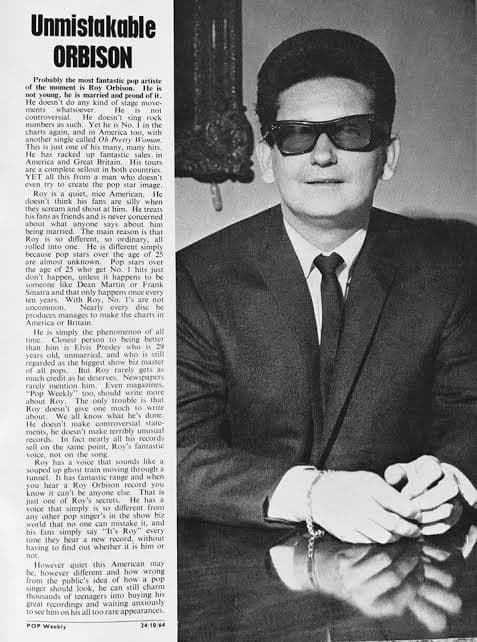
The live 1988 performance intensifies that emotional undercurrent. Standing beneath stark monochrome lighting, backed by a room filled with legendary musicians, Orbison appears almost untouched by age or industry trends. There is no attempt to modernize his persona. The dark glasses remain. The posture remains still and reserved. Yet the voice carries extraordinary warmth — rich, trembling, and impossibly controlled. In an era increasingly dominated by spectacle, Orbison reminded audiences that emotional truth required very little decoration.
Part of the enduring magic of “You Got It” lies in its contradiction. The arrangement is bright, melodic, and optimistic, but listeners inevitably hear it through the lens of mortality. Orbison died of a heart attack in December 1988, before the single became a worldwide success. As a result, the song acquired an unintended poignancy that no songwriter could have manufactured. What was originally a triumphant comeback became, almost overnight, a final curtain call.
Yet reducing the song to tragedy alone would diminish its achievement. “You Got It” endures because it captures something timeless about Orbison himself: tenderness without weakness, longing without bitterness, and romance without cynicism. Even decades later, the performance still feels intimate, as though Orbison is singing not to an audience of millions, but to one person he never stopped loving.
Few artists have ever made vulnerability sound so majestic. Fewer still have left behind a farewell that glowed with this much grace.