
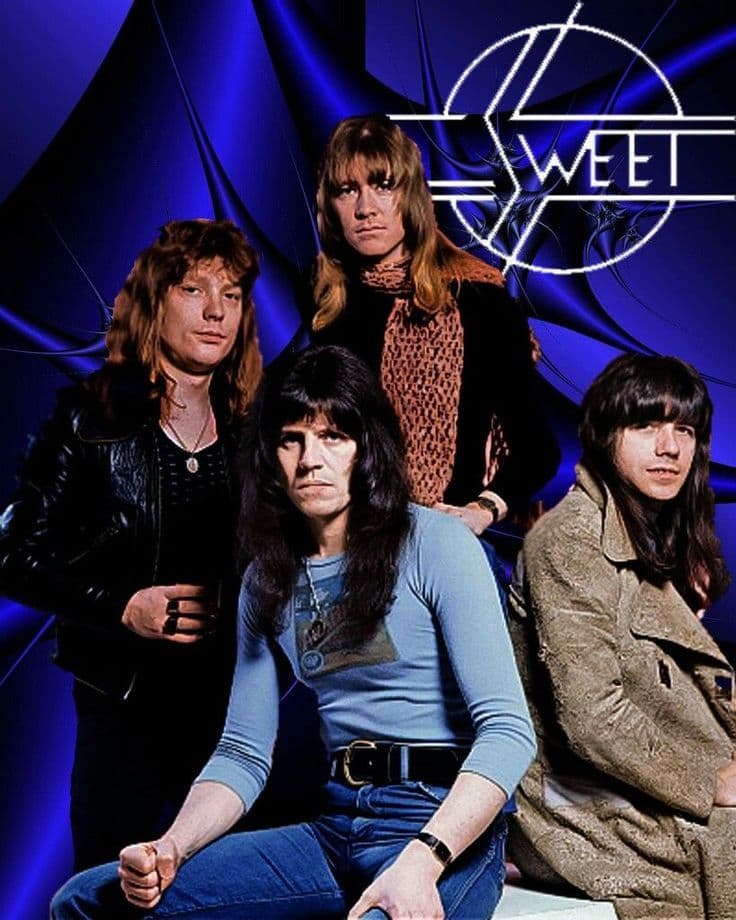
THE JOY OF DANCE MEETS THE EDGE OF GLAMOROUS REVELRY
When the English glam-rock force Sweet released their re-imagining of “PEPPERMINT TWIST” in 1974—drawn from their album Sweet Fanny Adams—they offered a spirited revival of the song’s 1961 origins. Their version charted notably in Australia, where it reached No. 4 on the Kent Music Report. Though originally penned by Joey Dee & the Starliters (with songwriter credits to Joey Dee and Henry Glover) and wildly successful in its own time, Sweet’s version takes the twist craze of the early ‘60s and refracts it through the swagger and style of mid-‘70s rock.
In the opening drums and guitar of Sweet’s take, you don’t hear an echo of nostalgia; you hear rebellion. The original “Peppermint Twist” thrived as a straightforward dance-floor anthem: a call to “do the dance” in the slick neon of New York’s Peppermint Lounge. But Sweet, firmly in the glam era, twist that simplicity into something sharper—guitars that edge, vocals with swagger, a beat that invites movement yet hints at excess. That tension between joyous release and rock-influenced bite defines the piece. It occupies that rare space where revival meets reinvention.
Lyrically, the “twist” becomes a metaphor for motion, connection, the communal: the repeated chant of “Yeah yeah the Peppermint Twist” is not just a prompt to the floor, but a shimmering invocation of the era’s unspoken promise—escape through dance. In Sweet’s hands, that promise feels slightly chipped by the sheen of glam: the honeyed harmonies and pulsing drums suggest that the dance might last all night, but the morning will come. The track reveals itself not only as nostalgia for a dance craze, but as commentary on performance, identity, and the ephemeral nature of delight.
Consider the placement of the song. Sweet included it on Sweet Fanny Adams, a hard-rock tinged album that many regard as a pivot point away from their earlier bubble-gum-pop roots. So “Peppermint Twist” stands out as almost an anomaly—a harking back to simpler pop-dance days while the rest of the record marches into heavier territory. That choice signals something: that they understood the song as heritage, yes—but also as a statement. Here was glam rock embracing its lineage even while striding into its darker horizons.
In the broader arc of rock history, Sweet’s version reminds us that the past isn’t only to be remembered—it’s to be re-felt. The original twist craze captured a moment of youthful exuberance—men and women tightly packed on dance floors, mid-century optimism pulsing through their limbs. Sweet’s homage pulses with that same floor-filled energy, but tinted by pre-punk tension and the high polish of brit-glam. Hearing it now, one senses not only the stomp of the beat, but the glitter of costumes, the roar of a crowd, the moment when style and sweat became inseparable.
For the seasoned vinyl lover, “Peppermint Twist” in Sweet’s version is a delightful paradox: a cover that doesn’t just reproduce, but provocatively reframes. It invites you back onto the dance floor, yes—and then reminds you that you’ve changed since you last danced. The twist remains a twist, but the music around it has deepened. In that way, Sweet’s “Peppermint Twist” becomes less of a footnote and more of a bridge—between the innocence of the early 1960s and the charged, glamorous rock world of the mid-1970s.