
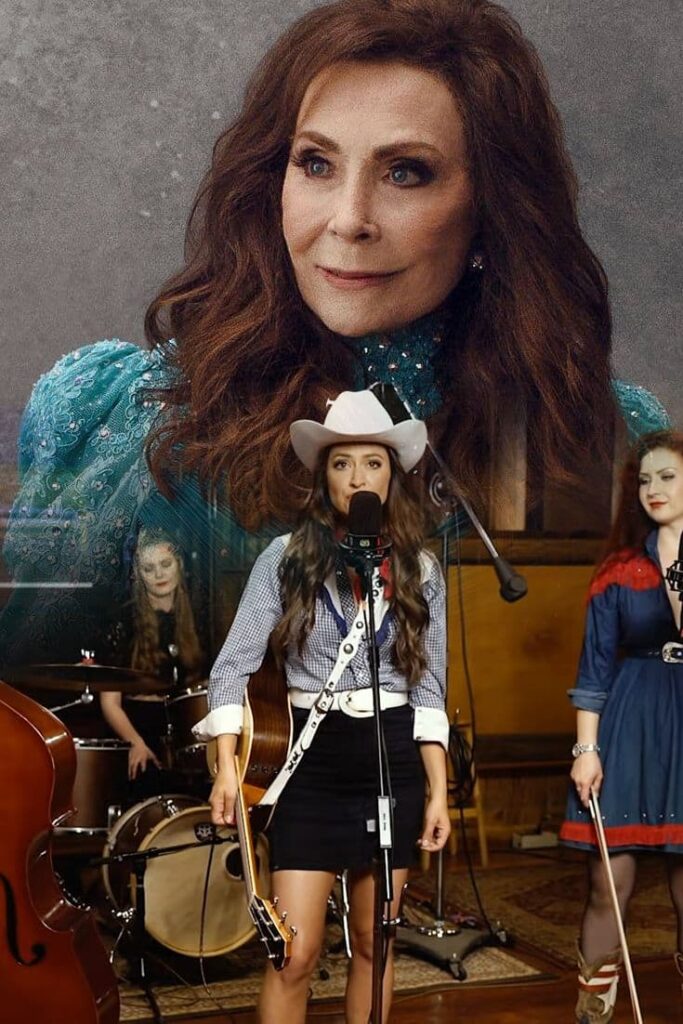
A defiant declaration of dignity from a woman who refuses to surrender her love or her place
When Loretta Lynn released You Ain’t Woman Enough (To Take My Man), the song did more than climb the charts. It became a landmark moment in country music’s evolving voice of female strength. The single reached No. 2 on the Billboard Hot Country Singles chart and later gave its title to Lynn’s 1966 album You Ain’t Woman Enough. At a time when country music was still largely shaped by male perspectives, Loretta Lynn stepped forward with a voice that was fearless, direct, and unmistakably authentic. The song did not simply tell a story of jealousy. It issued a challenge.
What makes You Ain’t Woman Enough (To Take My Man) so striking is its simplicity. The narrative unfolds like a conversation overheard in a small-town kitchen or across a barroom table. A woman confronts another who has been circling her relationship, and instead of pleading, she stands her ground with calm certainty. The emotional power lies not in rage but in confidence. The singer knows her worth, and that assurance becomes the spine of the entire song.
For Loretta Lynn, this perspective was deeply personal and culturally significant. Raised in the coal-mining community of Butcher Hollow, Kentucky, Lynn carried into her music the realities of working-class life. Her songs rarely dressed emotions in poetic abstraction. They spoke plainly, often bluntly, about love, marriage, loyalty, and betrayal. You Ain’t Woman Enough (To Take My Man) embodies that approach perfectly. It is country storytelling stripped down to its emotional core.
Musically, the arrangement reflects the clean, traditional Nashville sound of the mid-1960s. The steady rhythm section, the gentle sweep of steel guitar, and the bright punctuation of electric guitar create a framework that allows Lynn’s voice to command the spotlight. There is a subtle tension between the softness of the instrumentation and the steel in her words. That contrast gives the recording its enduring bite.
What truly sets the song apart, however, is its perspective within the broader tradition of country music narratives. Earlier songs about love triangles often portrayed women as rivals locked in quiet suffering. Loretta Lynn turned that dynamic on its head. Instead of victimhood, she offered confrontation. Instead of heartbreak, she delivered resolve. The result was not merely a hit record but a statement about identity and self-respect.
Over time, You Ain’t Woman Enough (To Take My Man) came to represent a turning point in Lynn’s career. It confirmed her ability to transform everyday experiences into songs that resonated far beyond the rural communities from which they emerged. The voice in the song is not glamorous or distant. It is human, grounded, and fiercely self-aware.
Decades later, the song remains one of the defining recordings in the catalog of Loretta Lynn. Its message continues to echo through generations of country music artists who followed her path. In just a few minutes of music, You Ain’t Woman Enough (To Take My Man) captured a truth that felt both timeless and revolutionary: strength can speak softly, but when it does, it leaves no room for doubt.