
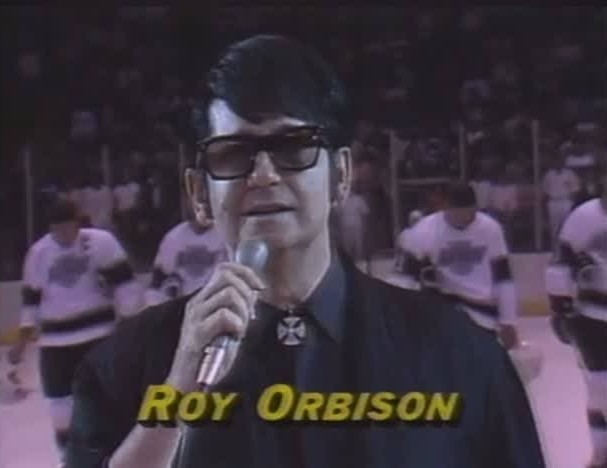
A fragile, unearthly voice transforms a national anthem into a moment of quiet transcendence
On October 6, 1988, just weeks before his passing, Roy Orbison stood before a crowd at the Los Angeles Kings game and delivered The Star-Spangled Banner with a gravity that felt almost otherworldly. Unlike his chart-dominating singles from albums such as Mystery Girl, this performance was never about commercial success or placement. It existed outside the machinery of charts and radio, occupying instead a rarer space where voice, moment, and legacy converge. What remains is not a statistic, but an echo—one of the final public documents of a voice that had already reshaped the emotional vocabulary of popular music.
By that point in his life, Roy Orbison was no longer simply a singer of heartbreak ballads. He had become an institution of feeling, a figure whose voice carried an operatic intensity rarely matched in rock and roll. The performance of The Star-Spangled Banner that night is striking precisely because it strips away the dramatic orchestration typically associated with his greatest hits. There are no sweeping string arrangements, no carefully constructed crescendos designed for radio. Instead, what emerges is something more intimate and, paradoxically, more powerful.
Orbison approaches the anthem with restraint. Each phrase is measured, almost reverent, as though he is carefully placing each note into the air rather than projecting it outward. This interpretive choice transforms the song. Where many renditions of The Star-Spangled Banner lean into bravado or technical display, Orbison leans inward. The result is a performance that feels less like a declaration and more like a meditation.
There is an undeniable poignancy in this moment when viewed through the lens of time. In the closing months of his life, Roy Orbison had already begun experiencing a resurgence, collaborating with fellow legends and preparing material that would reaffirm his relevance to a new generation. Yet here, standing before a hockey arena crowd, he offers something profoundly unguarded. The voice that once soared through songs of romantic despair now carries a different weight—one shaped by endurance, loss, and quiet resilience.
Musically, what defines this rendition is Orbison’s control of space. He allows silence to exist between phrases, letting the notes linger just long enough to create tension without ever overwhelming the listener. His signature vibrato, subtle yet unmistakable, gives the anthem a trembling quality, as if the song itself is alive, breathing in real time. It is not a reinvention of the melody, but a recontextualization of its emotional core.
The cultural resonance of this performance lies not in spectacle, but in sincerity. The Star-Spangled Banner, in Orbison’s hands, becomes less about national identity and more about human vulnerability. It is a reminder that even the most familiar songs can reveal new dimensions when filtered through a singular voice.
In retrospect, the performance feels almost like a quiet farewell. Not an announcement, not a grand gesture, but a fleeting moment where time seems to slow, and a legendary voice offers one last, unembellished truth.