
A fleeting glance becomes eternal desire, where longing burns brighter than possession
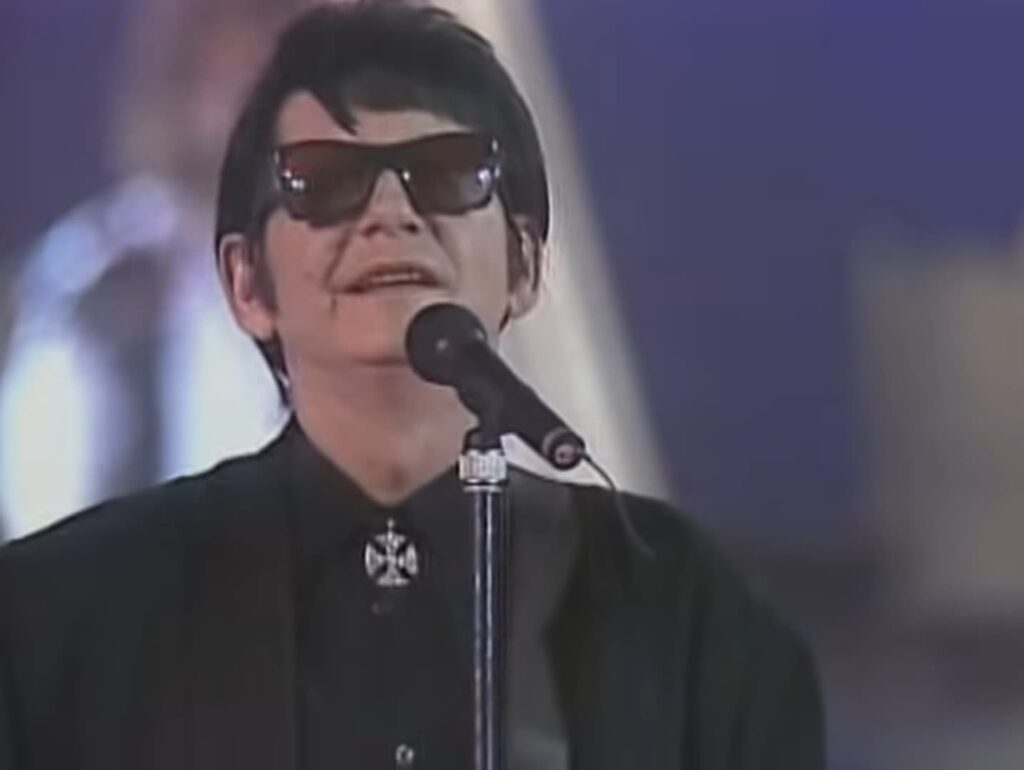
When Roy Orbison released Oh, Pretty Woman in 1964, it surged to No. 1 on the Billboard Hot 100 and claimed the top spot in the UK, later becoming a defining centerpiece of his catalog and appearing on compilations such as Oh, Pretty Woman. Yet it is in the electrifying 1988 performance, captured during the legendary Black & White Night concert, that the song finds a second life. Here, Roy Orbison, backed by an extraordinary ensemble of peers and admirers, revisits his signature hit not as a relic of past success, but as a living, breathing testament to his enduring artistry.
The origins of Oh, Pretty Woman are deceptively simple. Co-written with Bill Dees, the song was reportedly inspired by a casual moment, a passing remark about an attractive woman walking by. But what emerged from that spark was far more than a novelty. Orbison transformed an everyday encounter into a universal emotional experience, distilling the electric tension of attraction into a structure that feels both immediate and timeless. The famous opening guitar riff does not merely introduce the song, it announces it with authority, a rhythmic strut that mirrors the confident yet vulnerable gaze of its narrator.
By 1988, when Roy Orbison stepped onto the stage for Black & White Night, the cultural landscape had shifted dramatically. Rock and roll had splintered into countless forms, yet Orbison’s voice remained untouched by time. There is something almost uncanny in that performance. The years fall away the moment he begins to sing. His voice, rich and operatic, carries the same ache, the same restrained yearning that defined the original recording. But now, there is an added dimension, a sense of reflection, of an artist revisiting not just a song, but a lifetime of emotion embedded within it.
What makes Oh, Pretty Woman endure is its delicate balance between boldness and vulnerability. The lyrics project confidence, the swagger of a man captivated by beauty, yet beneath that surface lies uncertainty. The turning point arrives when rejection seems inevitable, only for the narrative to pivot in a moment of unexpected grace. It is a subtle emotional arc, but one that resonates deeply. The listener is drawn into that fragile space between hope and disappointment, a place where desire is both exhilarating and terrifying.
In the 1988 live performance, this emotional complexity is amplified by the setting. Surrounded by fellow musicians who clearly revere him, Roy Orbison stands at the center, not as a relic of the past, but as its architect. The applause, the interplay between instruments, the visible admiration on stage, all contribute to a sense of occasion. Yet Orbison himself remains composed, almost understated, allowing the song to carry the weight of expression.
Decades after its release, Oh, Pretty Woman continues to resonate because it captures a moment everyone understands. The instant when admiration becomes courage, when a fleeting encounter feels like destiny. In the hands of Roy Orbison, and especially in that luminous 1988 performance, it becomes something more enduring. A reminder that even the simplest emotions, when expressed with sincerity and artistry, can echo across generations.