
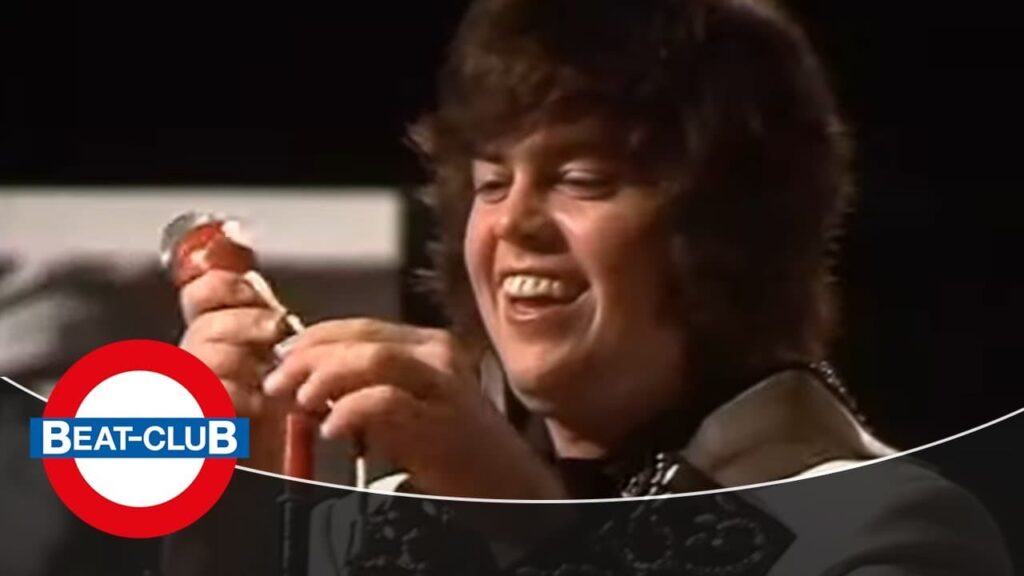
A clean-cut pop phenomenon suddenly turned up the amplifiers and revealed the restless pulse beneath the smile.
When The Osmonds released “Hold Her Tight” in the summer of 1972, the song climbed to No. 14 on the Billboard Hot 100 and became one of the defining moments from the album Crazy Horses, a record that startled listeners who still associated the group with polished family-pop harmonies and television innocence. By then, the brothers were no longer content to exist merely as teen idols manufactured for screaming arenas and magazine covers. With “Hold Her Tight,” they pushed deeper into a rougher, heavier rock vocabulary, signaling that the Osmonds were listening closely to the hard-edged British rock revolution reshaping the early seventies.
What makes the record fascinating more than fifty years later is not simply its commercial success, but the tension living inside it. This is a song caught between worlds. On one hand, there is youthful urgency, almost breathless in its insistence. On the other, there is a band fighting against its own public image. The pounding rhythm, the aggressive guitar attack, and the near-feral energy of the chorus feel worlds away from the sanitized expectations attached to the Osmond name. Even the opening riff carries the shadow of the heavier rock records dominating FM radio at the time, revealing a group eager to prove they belonged in the same musical conversation as harder contemporary acts.
Yet beneath the muscular production lies something unmistakably adolescent and vulnerable. The title itself, “Hold Her Tight,” sounds simple enough, but the performance transforms that simplicity into desperation. The song is not about sophistication. It is about immediacy. About the fear of losing connection before one has even fully understood love itself. Merrill Osmond’s lead vocal carries that contradiction beautifully. He sings with confidence, but also with the nervous urgency of someone trying to outrun uncertainty. That emotional duality gives the record its staying power.
The broader context of Crazy Horses also deepens the song’s meaning. By 1972, popular music had become darker, louder, and more socially conscious. The innocence of the previous decade was evaporating beneath political unrest, cultural fragmentation, and the growing dominance of album-oriented rock. The Osmonds could have remained safely inside their commercial formula. Instead, they gambled on reinvention. “Hold Her Tight” became part of that transformation, standing as evidence that the brothers were not merely performers but active musicians and writers shaping their own direction. Alan, Wayne, and Merrill Osmond wrote the song themselves, further reinforcing the group’s determination to be taken seriously beyond the confines of teen fandom.
Listening now, the record feels almost rebellious in hindsight. Not rebellious in the dangerous sense cultivated by many rock bands of the era, but rebellious against expectation itself. The Osmonds understood that audiences often imprison artists inside simplified identities. “Hold Her Tight” pushed against that prison wall with distortion, sweat, and raw momentum.
And perhaps that is why the song still resonates. Beneath the glitter of early seventies pop culture, it captures a universal moment in every artist’s life: the aching need to be seen differently than the world insists on seeing you.