
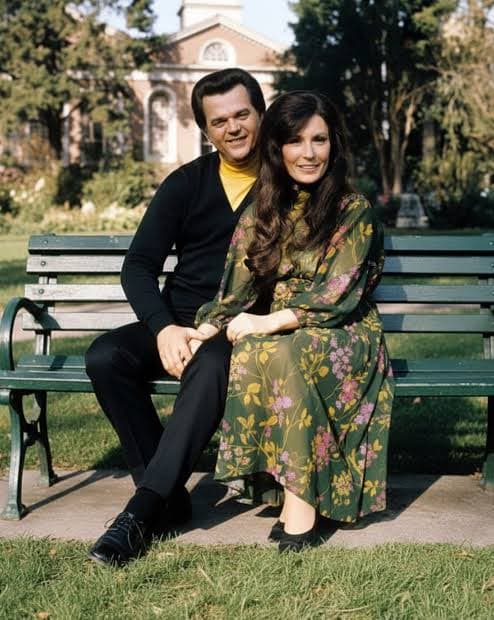
A love so essential it becomes both sanctuary and quiet surrender
By the time Conway Twitty and Loretta Lynn recorded The One I Can’t Live Without, they had already solidified their place as country music’s most compelling duet partners, a partnership that yielded consistent chart success throughout the 1970s. Released as part of their collaborative album Dynamic Duo, the song continued their remarkable run on the Billboard Hot Country Singles chart, where their duets regularly climbed into the upper reaches, reaffirming their unmatched chemistry and audience appeal.
What distinguishes The One I Can’t Live Without is not grandiosity, but restraint. It unfolds like a private confession shared between two voices that know each other too well to exaggerate. In the long tradition of country duets, Twitty and Lynn had often explored tension, betrayal, and reconciliation. Here, however, the emotional register shifts toward something quieter yet more profound: dependence not as weakness, but as an acknowledgment of emotional truth.
The narrative is deceptively simple. Two lovers, bound not by circumstance but by an unspoken understanding, admit that separation is unthinkable. Yet beneath that simplicity lies a complex emotional architecture. The song does not dramatize its sentiment with sweeping declarations. Instead, it leans into subtlety. Each line feels lived-in, as though drawn from years of shared experience rather than fleeting passion.
Musically, the arrangement reflects the Nashville sound of its era—polished, measured, and deeply attentive to vocal interplay. The instrumentation never intrudes. It serves as a soft frame for the true centerpiece: the dialogue between Conway Twitty’s warm, resonant baritone and Loretta Lynn’s clear, emotionally direct delivery. Their voices do not compete; they complement, weaving together in a way that suggests not just harmony, but mutual recognition.
There is a particular power in how the two singers inhabit their roles. Twitty often brings a sense of quiet assurance, his phrasing grounded and steady. Lynn, by contrast, carries an emotional immediacy that cuts straight to the listener. When these elements converge in The One I Can’t Live Without, the result is something that transcends performance. It feels like a conversation overheard rather than a song performed.
The cultural significance of their partnership cannot be overstated. At a time when country music frequently portrayed relationships through singular perspectives, Conway Twitty and Loretta Lynn offered something more balanced. Their duets allowed for dual viewpoints, creating a richer emotional landscape. This song stands as a testament to that dynamic, illustrating how love can be both shared and individually felt.
In the end, The One I Can’t Live Without lingers not because of its melody alone, but because of its emotional honesty. It speaks to a universal realization: that in a world defined by change and uncertainty, there are rare connections that anchor us. And sometimes, to admit that we cannot live without someone is not a loss of independence, but the clearest expression of what it means to truly belong.