
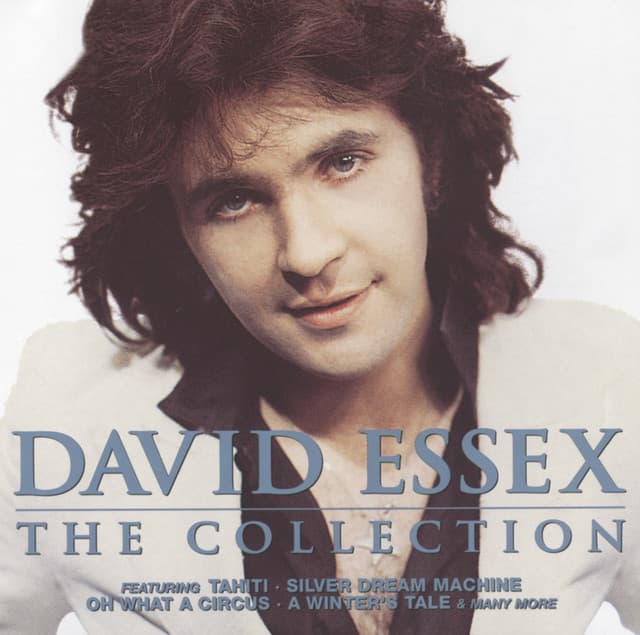
A fragile longing cast into the dark, hoping love might answer from beyond reach
Within the evolving catalog of David Essex, the song Fishing For The Moon emerges from the reflective depths of his mid-1970s work, most notably associated with the album All the Fun of the Fair. Released during a period when Essex had already tasted significant commercial success, the album itself reached No. 3 on the UK Albums Chart, affirming his place in the upper tier of British pop. Though Fishing For The Moon was not issued as a major charting single, it occupies a more intimate space within the record, offering a contrast to the brighter, more immediate hits that defined the era.
To understand Fishing For The Moon is to step away from the spotlight and into the quieter corners of Essex’s artistry. This is not the voice of a performer seeking applause, but of a storyteller searching for meaning. The title alone suggests an impossible act, an image steeped in poetic futility. Fishing, an act grounded in patience and practicality, is here redirected toward something unreachable, something celestial. It is a metaphor that speaks volumes about emotional risk and the human tendency to pursue what cannot easily be held.
Musically, the song leans into a gentle, almost lullaby-like structure. Essex’s vocal delivery is restrained, carrying a softness that feels deliberate rather than incidental. There is an absence of urgency, replaced instead by a slow, drifting rhythm that mirrors the act of waiting. The arrangement does not overwhelm; it supports. Subtle instrumentation allows the listener to focus on tone and nuance, on the spaces between phrases as much as the words themselves.
Lyrically, Fishing For The Moon dwells in ambiguity. It resists the direct narrative arc found in more conventional pop songs, opting instead for impressionistic imagery. The listener is invited to interpret rather than simply absorb. Is the moon a lost love, an unattainable dream, or a reflection of one’s own inner distance? Essex does not impose a singular meaning. Instead, he creates a landscape where longing can exist without resolution.
This approach aligns closely with the broader sensibility of David Essex during this phase of his career. While his public image often leaned toward youthful charm and accessibility, his songwriting revealed a more introspective core. All the Fun of the Fair as an album balances theatricality with introspection, and Fishing For The Moon stands firmly on the latter side of that divide.
In the years since its release, the song has retained a quiet resonance. It does not demand attention, nor does it rely on dramatic crescendos or overt declarations. Its power lies in suggestion, in the delicate articulation of yearning that never quite finds its answer. For those willing to listen closely, Fishing For The Moon offers something enduring: a meditation on desire that feels as distant, and as haunting, as the moon itself.