
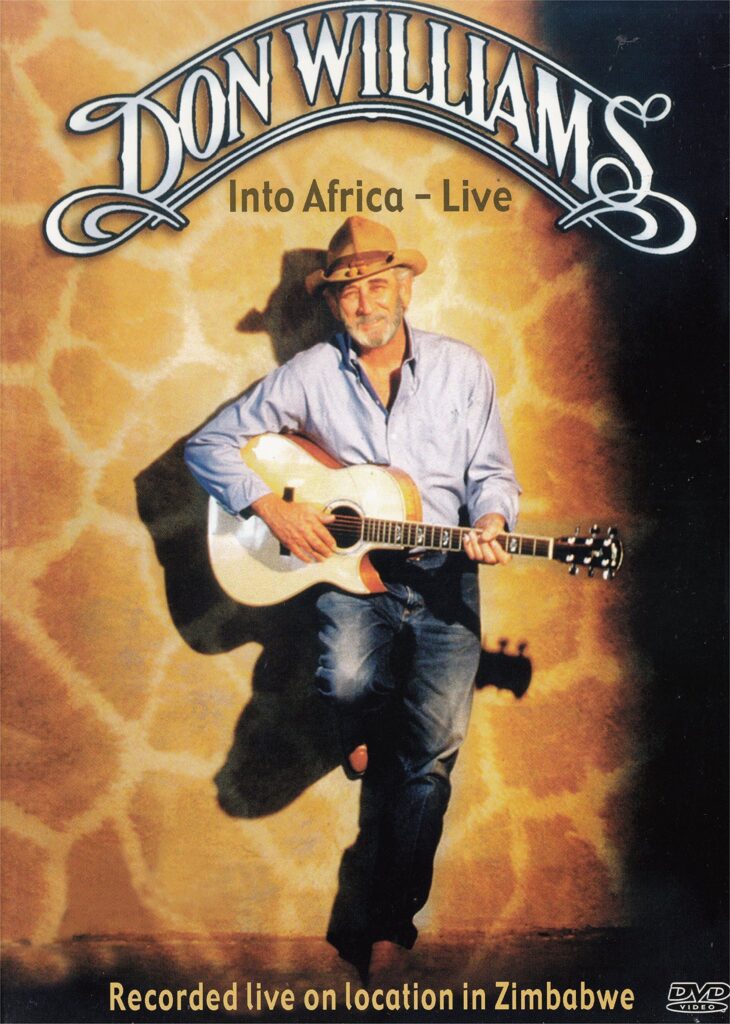
WHEN A QUIET TEXAS VOICE FOUND A SECOND HOME IN AFRICA
By 1997, Don Williams was no longer chasing the machinery of Nashville fame. The chart wars had already been won years earlier. Between 1974 and 1991, the man known as “The Gentle Giant” had amassed 17 No. 1 country hits and built one of the most quietly dominant careers in American music. Yet “Live in Harare 1997”, later associated with the concert film Into Africa, revealed something even more remarkable than commercial success: the discovery that his music had taken root thousands of miles beyond the American South. The performances in Harare, Zimbabwe, were not tied to a new chart campaign or a major comeback album. Instead, they became living proof that sincerity can travel farther than hype ever could.
There is something deeply moving about watching Don Williams stand before an African audience that already knew every word long before he arrived. No theatrics. No towering stage production. No attempt to reinvent himself for a changing era. He walked onstage carrying the same calm dignity that had defined his records since the 1970s. And somehow, that restraint became the spectacle.
For decades, country music was often treated as a distinctly American language, bound to dusty highways, Southern accents, and rural memory. But the Harare performances shattered that illusion. Songs like “You’re My Best Friend”, “Amanda”, and “Lord, I Hope This Day Is Good” were no longer simply country standards from Tennessee. In Zimbabwe, Kenya, and across parts of Africa, they had become deeply personal songs woven into ordinary life. Listeners carried them into marriages, heartbreaks, family gatherings, and lonely evenings. The emotional vocabulary of Don Williams transcended geography because he sang not about mythology, but about emotional truth.
What made Williams extraordinary was his refusal to oversell emotion. His voice rarely begged for attention. It settled into a listener’s life almost gently, like conversation heard late at night from another room. In an era when country music increasingly leaned toward spectacle and arena-sized bravado, Williams remained rooted in patience and understatement. That quality explains why the Harare crowd feels almost spiritual in retrospect. The audience was not merely cheering a celebrity. They were greeting someone who had quietly accompanied their lives for years.
The film and recordings from Into Africa carry another layer of significance now. They captured a moment before global music culture became flattened by algorithms and instant trends. Back then, devotion spread differently. Through radio waves, cassette tapes, jukeboxes, and word of mouth. Somehow, the warmth in Don Williams’ baritone crossed oceans without needing translation. That is rare in any genre. It is even rarer in country music.
There is also an undeniable poignancy in seeing Williams during this stage of his life. By the late 1990s, he already carried the aura of an elder statesman. His performances in Harare feel less like a man trying to prove himself and more like an artist finally witnessing the full reach of his own legacy. The songs breathe differently there. Slower. Deeper. Almost grateful.
Many artists spend careers searching for reinvention. Don Williams discovered something more enduring: permanence through honesty. “Live in Harare 1997” remains powerful because it documents more than a concert. It documents recognition. An American country singer arriving in Zimbabwe only to realize the music had gotten there long before he did.