
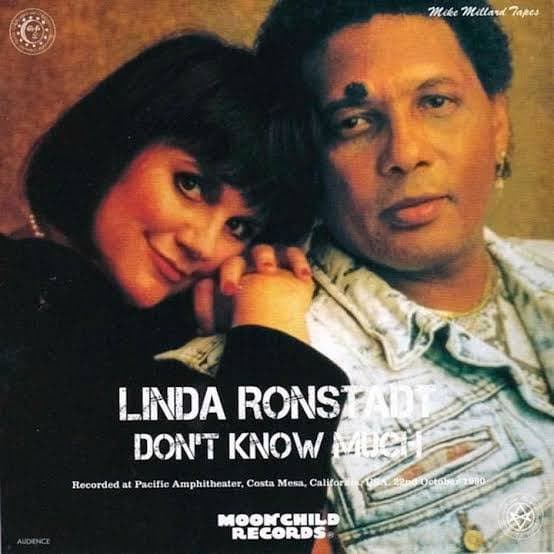
A quiet confession of love, where two voices discover that feeling can matter more than knowledge
When Linda Ronstadt and Aaron Neville recorded “Don’t Know Much,” they created a moment of musical intimacy that resonated widely upon its release in 1989. Featured on Cry Like a Rainstorm, Howl Like the Wind, one of Linda Ronstadt’s most carefully crafted late-career albums, the duet quickly became a defining highlight of the record. The song climbed to No. 2 on the Billboard Hot 100 and reached No. 1 on the Adult Contemporary chart, transforming an already admired album into a landmark collaboration. What could have been just another studio pairing instead became one of the most tender and recognizable duets of its era.
The origins of “Don’t Know Much” stretch back several years before Ronstadt and Neville ever entered the studio together. Written by songwriters Barry Mann, Cynthia Weil, and Tom Snow, the composition first appeared in the early 1980s but initially passed by with little cultural ripple. Like many songs waiting for the right voices, it needed performers who could transform its modest premise into something emotionally profound. That moment arrived when Ronstadt and Neville brought their contrasting yet complementary styles to the piece.
What makes the recording so remarkable is the delicate balance between the two singers. Linda Ronstadt, whose voice had long carried the authority of a seasoned interpreter of rock, country, and pop standards, approaches the song with restrained warmth. Across from her stands Aaron Neville, whose fragile falsetto seems to float above the melody like a quiet prayer. Together they create a dialogue rather than a performance. Each line feels like a confession exchanged between two people who understand that love rarely arrives with certainty or explanation.
Lyrically, “Don’t Know Much” builds its emotional power through a series of gentle admissions. The narrator lists all the things he does not understand: history, science, the complicated knowledge that fills textbooks and lecture halls. Yet beneath those confessions lies a deeper truth. Even without intellectual certainty, the heart recognizes devotion. In that sense, the song is not about ignorance at all. It is about clarity. The characters realize that love can exist outside the systems that try to measure or define it.
Musically, the arrangement reflects that philosophy of simplicity. The production, guided with elegance and restraint, avoids overwhelming the vocalists. Soft orchestration, piano accents, and subtle rhythm create an atmosphere that feels almost timeless. Nothing in the instrumentation competes with the central emotional exchange between Ronstadt and Neville. Instead, the music gently frames their voices, allowing every tremor and breath to become part of the story.
The cultural legacy of “Don’t Know Much” rests not only in its chart success but also in its ability to capture a rare sincerity in popular music. In an era often dominated by grand gestures and glossy production, the duet stood apart for its quiet vulnerability. It reminded listeners that the most enduring love songs are rarely complicated. Sometimes they are built from the simplest admission imaginable: that even when knowledge fails, the heart still understands.
Decades later, the recording remains one of the most cherished entries in the catalogs of both Linda Ronstadt and Aaron Neville. It is the sound of two artists meeting in the middle of a melody and discovering that humility, tenderness, and honesty can create a kind of musical truth far deeper than any lesson found in books.